Gold traded at roughly 4,371 dollars an ounce in early September 2026, up close to 30 percent from a year earlier and within reach of its all-time high.1
In Mohave County, Arizona, a 3.4-kilometre vein system that is mineralized from surface has now been drill-defined over more than 1,000 metres of strike, and the company that owns 100 percent of it has told the market that its first mineral resource estimate is coming in the third or fourth quarter of 2026.2
That company has roughly 25 million dollars in the treasury, every single warrant in the money, four analysts covering it, and a ~21,000 metre drill program it has already finished paying for.2,3
This is the story of West Point Gold Corp. (OTCQX: WPGCF | TSX-V: WPG), and why the narrow window between the last drill hole and the first resource is the one that matters.
The Bottom Line, Before You Scroll
Most investors meet an exploration story at one of two wrong moments.
Too early, when there is a land package and a theory and nothing in the ground.
Or too late, when the resource has been published, the analysts have modelled it, and the re-rating already happened.
West Point Gold Corp. (OTCQX: WPGCF | TSX-V: WPG) is sitting in the narrow gap between those two moments, and the gap has a date on it.
Here is the situation in plain terms!
The Company's flagship is the Gold Chain Project in Mohave County, Arizona: 15 patented claims covering 282 acres, plus 614 BLM lode claims covering approximately 11,216 acres. Arizona State Route 68 runs adjacent to the property, power lines cross it, and subsurface water rights come attached to the patented claims.
This is not a helicopter-supported prospect at the end of a winter road.2
Inside that land package sits the Tyro Vein System: approximately 3.4 kilometres of vein mineralized from surface, open to the northeast, to the southwest, and at depth.2
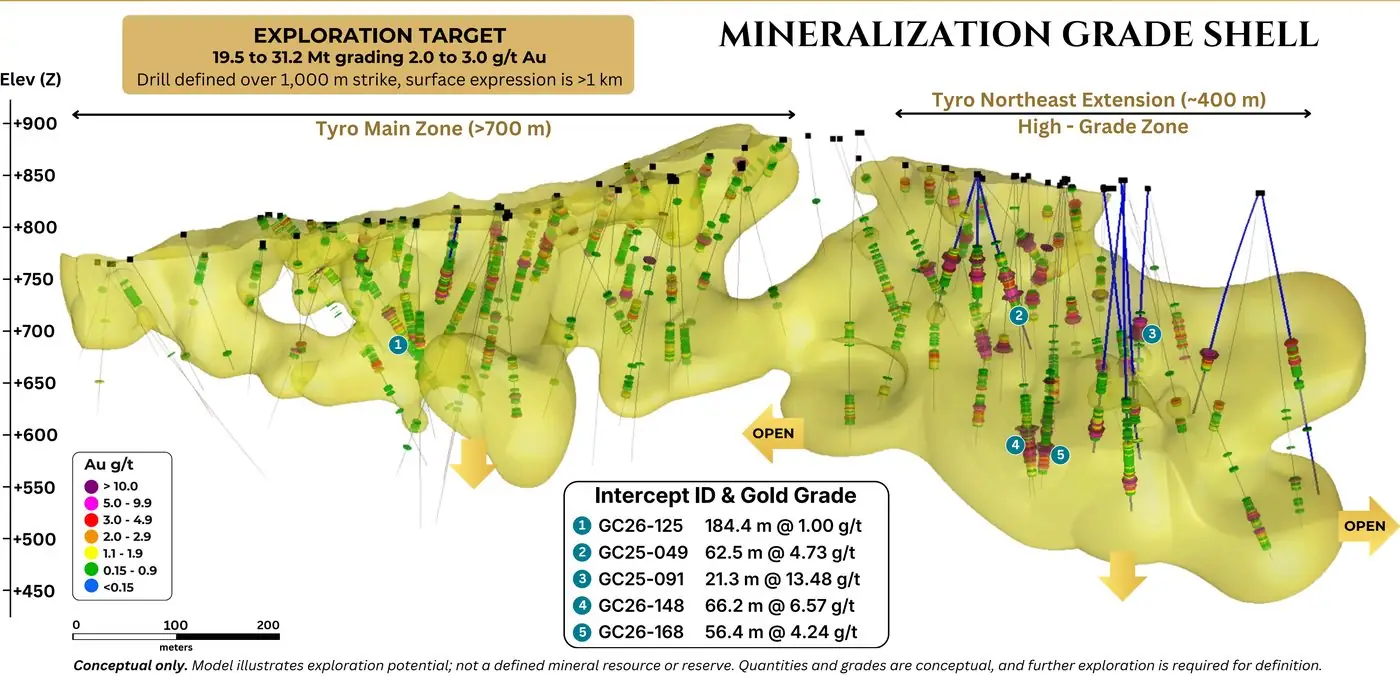
West Point Gold (OTCQX: WPGCF | TSX-V: WPG) has published an exploration target at Tyro of 19.5 to 31.2 million tonnes grading 2.0 to 3.0 grams per tonne gold. Run the arithmetic yourself, and that range describes roughly 1.25 to 3.0 million ounces of contained gold.2
And now the sentence that most promotional copy leaves out, which we are going to put up front, because it is exactly the gap that creates the opportunity: an exploration target is not a mineral resource.
The Company states plainly, on its own slide, that the potential quantity and grade are conceptual in nature, that there has been insufficient exploration drilling to define a mineral resource, and that it is uncertain whether further exploration will result in the target being delineated as a mineral resource.
West Point Gold (OTCQX: WPGCF | TSX-V: WPG) does not have a mineral resource on any of its properties today.2 That is precisely the point.
The entire thesis here is the conversion event!
You are not being asked to pay for ounces that have already been counted.
You are being asked to look at what happens when a company with this much drilling behind it counts them for the first time.
And the drilling behind it is substantial.
The Tyro Main Zone has been drill-defined over more than 700 metres, the Tyro Northeast Extension over approximately 400 metres, and the surface expression runs more than a kilometre.2
Hole GC26-148 returned 66.2 metres grading 6.57 grams per tonne gold, including 20.7 metres at 18.25 grams per tonne, more than 250 metres below surface and open at depth.4
Hole GC26-125 returned 184.4 metres grading 1.00 gram per tonne gold from surface.5
Hole GC26-091 returned 21.3 metres at 13.48 grams per tonne, extending the high-grade northeast zone over more than 300 metres of strike.6
Hole GC25-049 returned 30.5 metres at 9.05 grams per tonne within a wider 62.5 metres at 4.73 grams per tonne.7
Hole GC25-088 returned 44.2 metres at 5.46 grams per tonne including 18.3 metres at 12.04 grams per tonne.8
And hole GC26-159 returned 36.5 metres at 2.79 grams per tonne from 359.7 metres downhole, which tells you the system has not run out with depth.9
Now look at how the Company is priced against that.
West Point Gold Corp. (OTCQX: WPGCF | TSX-V: WPG) carried a market capitalization of approximately 164 million Canadian dollars.10
That is against 139.9 million basic shares outstanding and 166.1 million fully diluted, with working capital of approximately 25.1 million dollars.
There are 15.7 million warrants outstanding at a weighted average exercise price of 52 cents, and the Company states that 100 percent of them are in the money, representing roughly 8.2 million dollars of additional cash that arrives without a single new share being sold at a discount.2,3
Here is where we are going to be straight with you, because it changes how you should size this.
This is not a forgotten microcap that nobody has noticed.
West Point Gold (OTCQX: WPGCF | TSX-V: WPG) is covered by four research firms, sits on the register alongside VanEck, Mackenzie Investments, U.S. Global Investors, IXIOS Asset Management, Vestcor, Libra Advisors, Konwave AG and Kinross, trades roughly 250,000 shares a day across two exchanges, and was named to the “TSX Venture 50 for 2026”.
Insiders hold 6.4 percent and strategic and institutional holders another 24.9 percent.2
So, the pitch is not that you have found something invisible.
The pitch is narrower and, we would argue, more useful: you are being offered a position ahead of a specific, dated, company-guided event, in a company that does not need to raise money from you to get there.
That is the trade. Do your deep dive on West Point Gold Corp. (OTCQX: WPGCF | TSX-V: WPG) today, before the maiden resource, and not after it.
5 Reasons
West Point Gold Corp. (OTCQX: WPGCF | TSX-V: WPG) Deserves a Spot on Your Radar Right Now
- The catalyst is dated, and it is the one that matters.A maiden mineral resource estimate is guided for Q3/Q4 2026 at Gold Chain. In junior mining, the move from an exploration target to a first counted, categorised resource is the single event that forces analysts to build a model and the market to apply a value-per-ounce framework. Timing is company guidance and can move.2
- The exploration target is both large and high grade.19.5 to 31.2 million tonnes at 2.0 to 3.0 grams per tonne gold, drill-defined over 1,000 metres of strike, open to the northeast, southwest and at depth. Conceptual in nature; insufficient drilling to define a mineral resource.2
- The Company does not need your money to reach the catalyst.Roughly 25.1 million dollars of working capital, a ~21,000 metre drill program already completed, a recently announced 30,000 m drill program, and 15.7 million warrants — every one of which is in the money — worth approximately 8.2 million dollars in additional non-dilutive cash if exercised.2,3
- A major is paying to advance one of the Nevada projects.Under its Exploration and Option Agreement, Kinross is required to spend US$600,000 at Jefferson Canyon, keep the claims in good standing, and make the option payments during the term. Kinross can earn 70 percent for US$5,000,000 and a further 10 percent for another US$5,000,000.2
- Gold Chain is not a one-zone story.Sheep Trail returned 32.0 metres at 1.05 grams per tonne from near surface over a strike of more than a kilometre. Black Dyke returned 36.6 metres at 1.04 grams per tonne from surface. Bull 8 returned 21.4 metres at 1.01 grams per tonne and confirmed a district-scale corridor extending roughly 12 kilometres. Each is framed by the Company as a potential additional resource area.13
Why The Window Is Open Right Now
Markets move on events, and on the gap between what is true and what is priced.
For West Point Gold Corp. (OTCQX: WPGCF | TSX-V: WPG), several of those events are stacked into the next two quarters.
The ~21,000 metre drill program at Gold Chain is complete.2
The maiden mineral resource estimate is expected in the third or fourth quarter of 2026.
That is the moment an exploration target stops being conceptual and becomes a number a research analyst can put in a model.2
At Jefferson Canyon, Kinross is advancing permitting toward an initial drill program, on a four-year agreement term that commences upon receipt of the pending drill permit.
At Baxter Spring, the Company is designing and permitting a 5,000 metre program on a project with 128 historical drill holes behind it.2
We are going to be direct about what has not happened, because it matters to how you size a position. There is no mineral resource yet.
The exploration target is conceptual, and the Company says so.
Resource estimates routinely land below the top of a target range; cut-off grades and metal price assumptions can move the answer materially, and guided timelines in junior mining slip more often than they hold.
That is the risk, and it is also the reason the entry is where it is!
Every one of those items is a future event rather than a priced-in fact.
The quiet period where informed buyers could be initiating a position, before the crowd understands what is happening, is the period we are in now.
The Macro Backdrop: Gold Within Reach of Its All-Time High While the Ounces Are Still Being Counted
Most junior explorers have to make a case for why the metal price backdrop will improve.
West Point Gold Corp. (OTCQX: WPGCF | TSX-V: WPG) does not need to make that case. It has already happened.
Gold traded at approximately $4,371 per ounce on September 4, 2026, up 29.97% from a year earlier, up 7.40% in the prior month, and up more than 25% since early 2025, at what the market has been calling record levels.
We will also note, because it is honest and because it tells you something about the tape, that gold fell 2.67 percent in a single session that same week.
This metal moves in both directions.1
For a company about to publish its first resource, the gold price is not background colour. It is an input.
Mineral resource estimates are constrained by a metal price assumption and reported above a cut-off grade, and both of those are set with reference to where gold is trading.
A deposit outlined at today's gold price captures material that would have been left outside the shell three years ago.
West Point Gold (OTCQX: WPGCF | TSX-V: WPG) is counting its ounces for the first time into the strongest gold tape in a generation.
Gold Chain, Arizona: A District-Scale Epithermal System with Three Corridors
The Gold Chain Project sits in an active Arizona mining district with an operating mine and multiple exploration programs running, in a jurisdiction the Fraser Institute's 2025 Annual Survey of Mining Companies places fifth in the world for investment attractiveness.
The Company holds an operating permit issued in April 2017.2,14
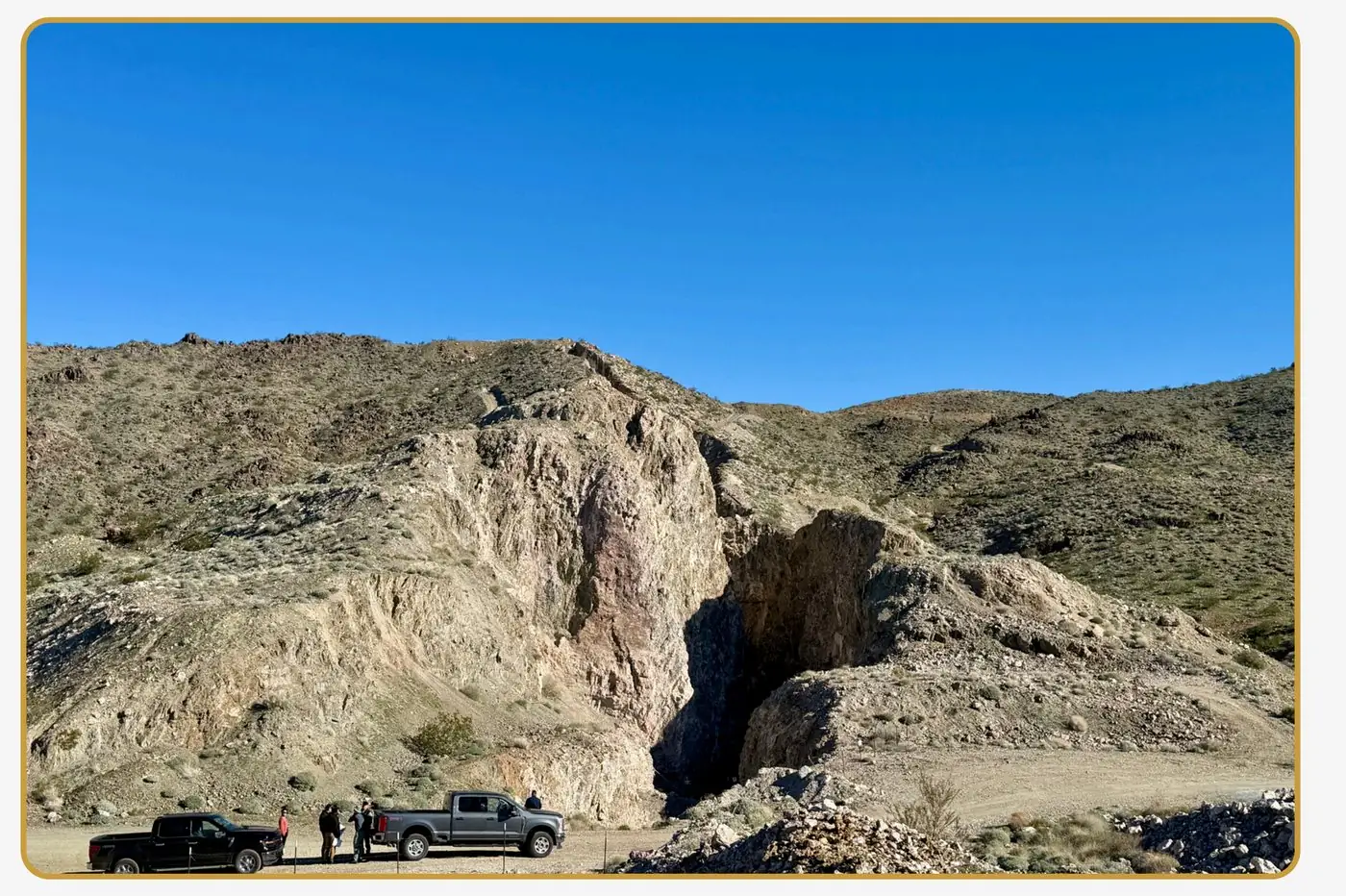
The project is not a single vein. Drilling, surface sampling and geophysics have defined three separate corridors.2
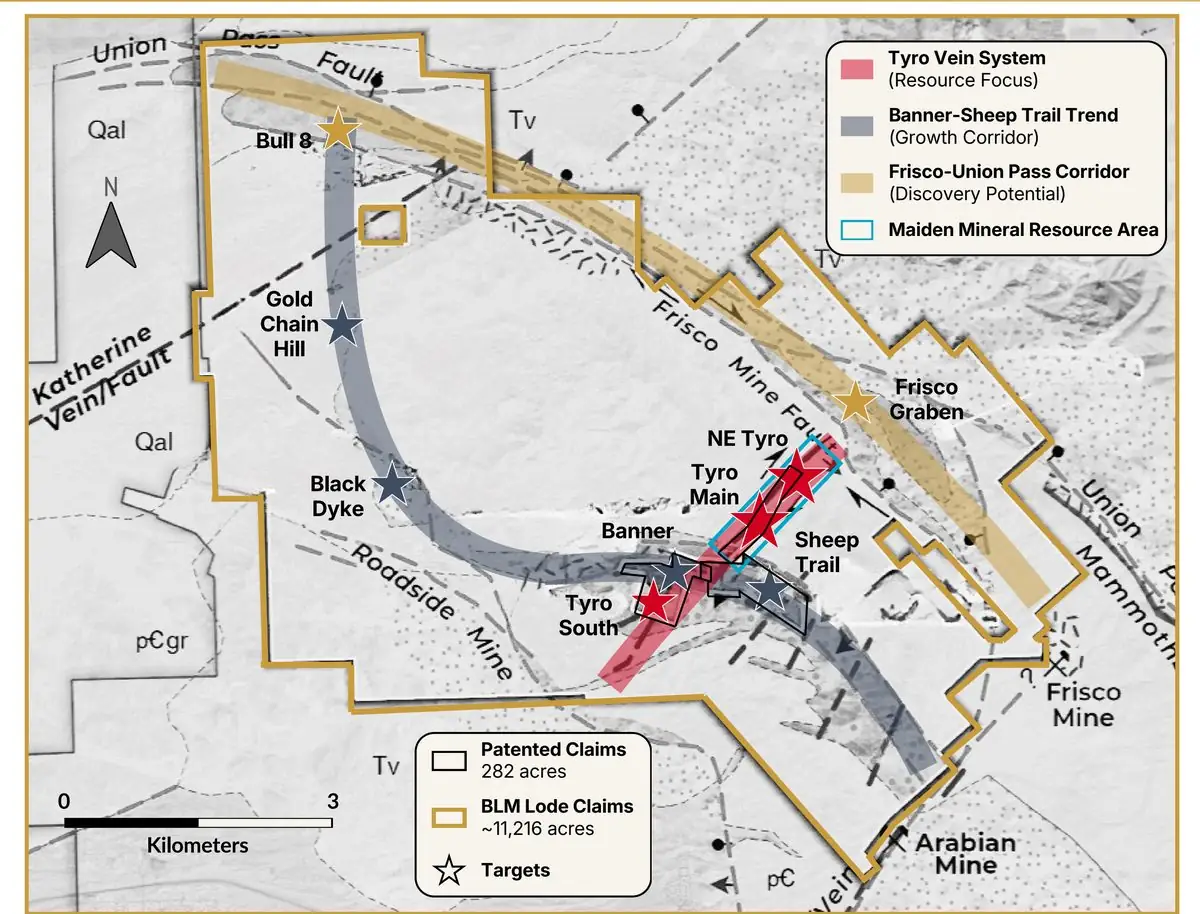
The Tyro Vein System is the resource focus: approximately 3.4 kilometres of structure, mineralized from surface, with the Tyro Main Zone accounting for about a kilometre of it.
The Banner–Sheep Trail Trend is a mineralized structural corridor running more than 15 kilometres, including Gold Chain Hill, Black Dyke, Banner and Sheep Trail, with over 2 kilometres of it sitting on patented claims.
The Frisco Graben–Union Pass Trend covers a target area roughly 4 kilometres long and 750 metres across, with the structural corridor extending approximately 12 kilometres across the project.2
The exploration target at Tyro Main Zone and the Northeast Extension is 19.5 to 31.2 million tonnes grading 2.0 to 3.0 grams per tonne gold, drill-defined over 1,000 metres of strike with a surface expression exceeding one kilometre.
The Company's own qualification travels with that number and should travel with it here: the potential quantity and grades are conceptual in nature, there has been insufficient exploration drilling to define a mineral resource, and it is uncertain if further exploration will result in the exploration target being delineated as a mineral resource.2
What the drilling has shown is a system with both bulk tonnage and high grade in it.
GC26-125 cut 184.4 metres at 1.00 gram per tonne from surface, which is the bulk-tonnage signature.5
GC26-148 cut 66.2 metres at 6.57 grams per tonne including 20.7 metres at 18.25 grams per tonne, more than 250 metres below surface, which is not.4
GC25-081 returned 36.6 metres at 7.35 grams per tonne including 25.9 metres at 9.95 grams per tonne, demonstrating strong vertical continuity.15
GC24-034 returned 42.8 metres at 2.50 grams per tonne including 11.7 metres at 5.94 grams per tonne, strengthening continuity toward the northeast.16
GC26-140 returned 18.3 metres at 6.05 grams per tonne, extending the system northeast toward the Frisco Graben, and GC26-151 returned 35.1 metres at 2.23 grams per tonne, confirming continuity along that extension and vertically.17
The cross-sections through the Tyro Main Zone, drawn from holes GC26-169, 142, 168, 161, 134, 136 and their neighbours, show a continuous high-grade structure rather than a scatter of isolated hits.18
There is one more detail worth knowing, and it is the sort of thing that separates a serious exploration company from a promotional one.
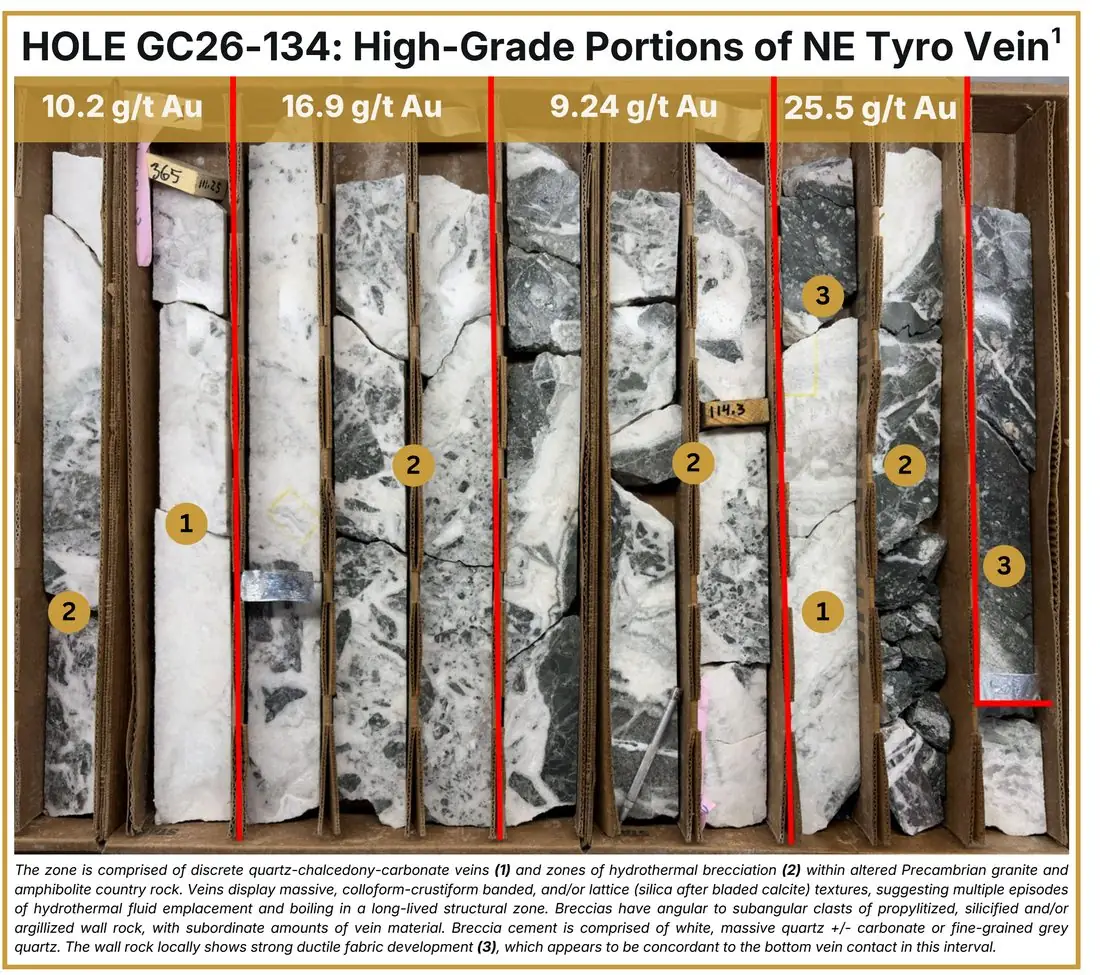
Core from hole GC26-134 in the Northeast Tyro vein returned discrete intervals grading 10.2, 16.9, 9.24 and 25.5 grams per tonne gold, hosted in quartz-chalcedony-carbonate veins and hydrothermal breccias within altered Precambrian granite, with massive, colloform-crustiform banded and lattice textures.
Those textures are the fingerprint of repeated boiling in a long-lived structural zone.
They are the reason the Company describes this as a district-scale system rather than a vein.4
Sheep Trail, Black Dyke and Bull 8: Three More Shots at the Same District
A maiden resource at Tyro is the near-term event.
What sits behind it is the reason a district-scale description is being used at all.
At Sheep Trail, roughly 600 metres south of the Tyro Main Zone, drilling returned 32.0 metres at 1.05 grams per tonne gold from 9.1 metres downhole, 19.8 metres at 1.42 grams per tonne, 15.3 metres at 1.24 grams per tonne, and 7.6 metres at 2.41 grams per tonne.
Mineralization starts within 60 metres of surface, runs more than a kilometre along strike, and step-out drilling has confirmed multiple parallel zones. The Company frames it as a potential third resource area.11
At Black Dyke, 1,230 metres were drilled across two phases, returning 36.6 metres at 1.04 grams per tonne from surface, 21.3 metres at 0.92 grams per tonne, 7.6 metres at 2.22 grams per tonne and 16.8 metres at 0.90 grams per tonne.
Widths are downhole, with true widths reported as more than 80 percent of downhole widths.
The Company has also compiled 74 historical Western States holes and collar data for 57 ACNC holes, and reports that historical intercepts grading more than 30 grams per tonne gold southwest of its own drilling are priority confirmation targets, with geophysics pointing to a northwest-trending feeder structure at depth.12
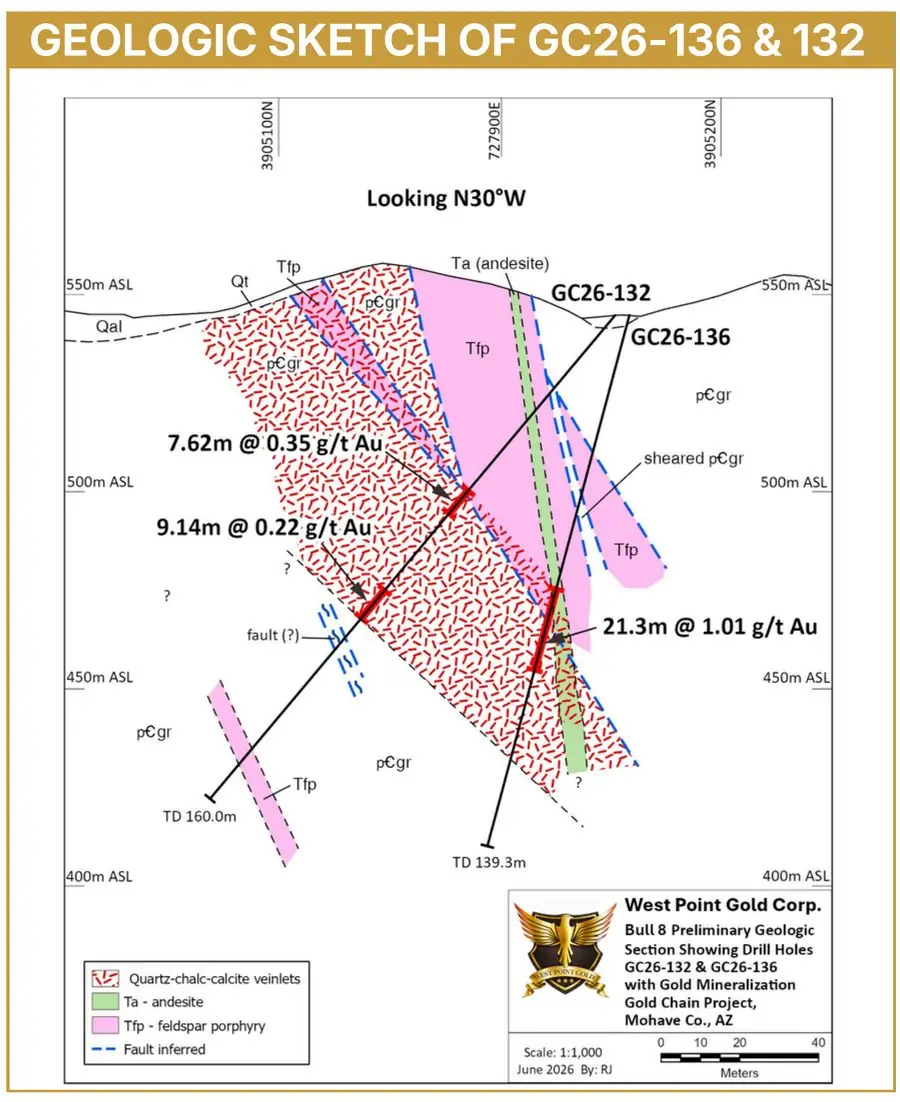
At Bull 8, about 6 kilometres northwest of the Tyro resource area, GC26-136 returned 21.4 metres at 1.01 grams per tonne gold and, in the Company's words, mineralization was intersected in every drill hole, with gold values increasing with depth.
That result is what unlocked the roughly 12-kilometre Union Pass structural corridor as a target pipeline and de-risked the Frisco Graben targets sitting along it.13
The Nevada Portfolio: Three Advanced Projects, One With a Major Paying the Bills
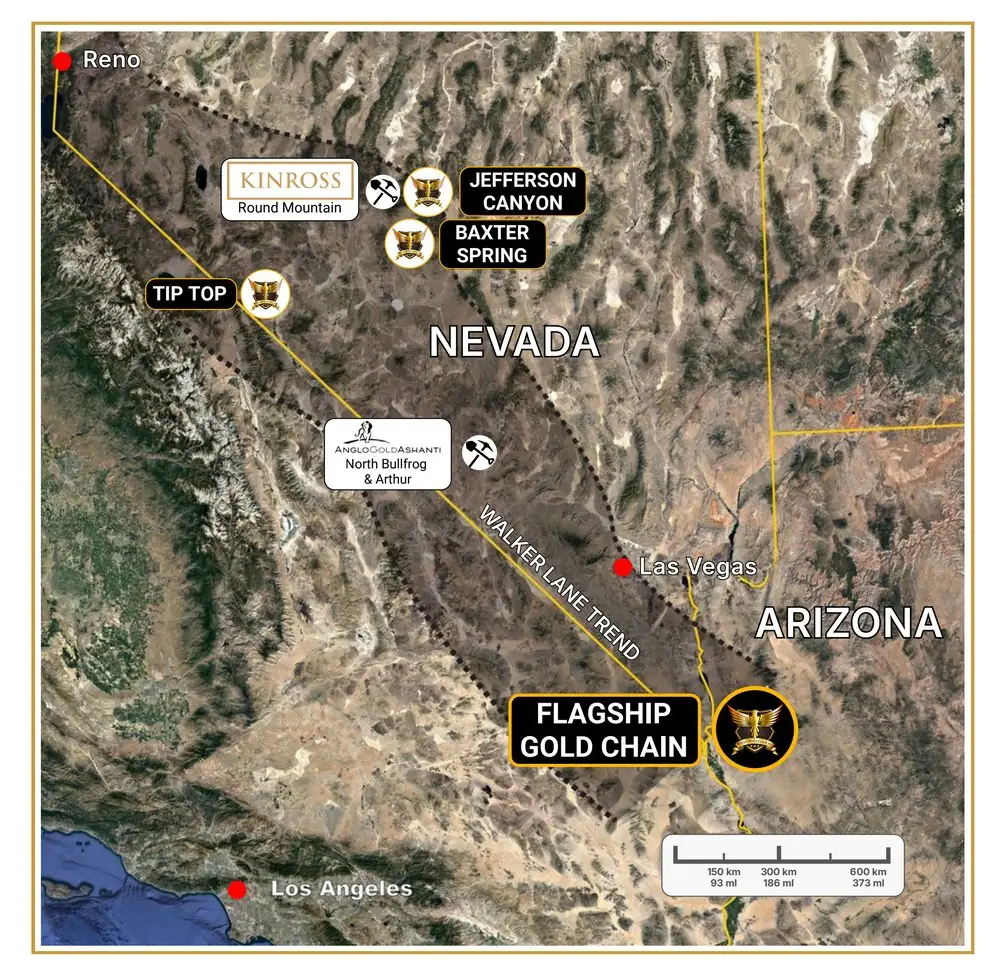
West Point Gold (OTCQX: WPGCF | TSX-V: WPG) holds three Nevada projects with more than 125 historical drill holes between them, in the jurisdiction the Fraser Institute's 2025 survey ranks first in the world.19
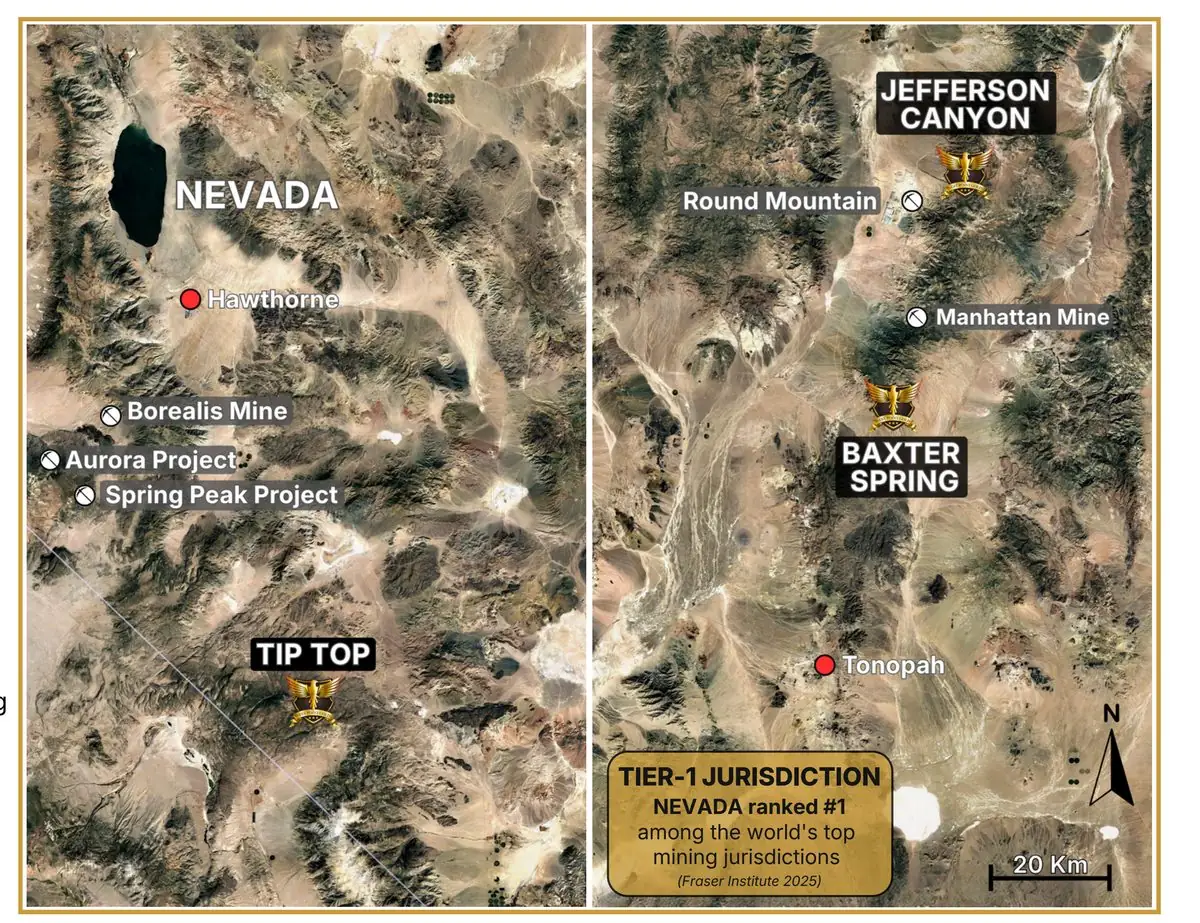
Baxter Spring, in Nye County, is 137 federal lode claims across approximately 2,829 acres, 40 kilometres from Kinross's Round Mountain Mine, and is 100 percent owned.
It carries 128 historical drill holes over roughly 13,000 metres, including hole BS-8 at 12.2 metres grading 60.3 grams per tonne gold, including 3.0 metres at 240 grams per tonne, plus BX-13 at 7.6 metres at 8.81 grams per tonne and BS-22 at 24.4 metres at 2.49 grams per tonne.
Multiple gold zones sit within 300 metres of surface in quartz-adularia-iron oxide veinlets, and drilling has intersected the Roberts Mountain Formation between 400 and 700 metres with alteration the Company describes as consistent with Carlin-type gold systems.
A 5,000 metre program is being designed and permitted.2
Jefferson Canyon is the one to understand structurally, because someone else is paying for it.
It sits 7 kilometres from Round Mountain, carries a 4 square kilometre gold-in-soil anomaly against Round Mountain's 5 square kilometre surface footprint, and has 145 historical drill holes behind it, highlighted by 41.2 metres at 6.4 grams per tonne gold and 402 grams per tonne silver.
Under the Exploration and Option Agreement, Kinross must spend US$600,000 in exploration work and keep the claims in good standing, and holds an option to acquire 70 percent of the project for US$5,000,000 and form a joint venture, with a further option on another 10 percent for US$5,000,000.
The term is four years from receipt of the pending drill permit. If a joint venture company is formed and either party is diluted below 10 percent, that interest converts to a 1 percent net smelter returns royalty. Kinross is currently advancing permitting for the initial drill program, and makes the option payments during the term of the agreement.2
Tip Top, in Esmeralda County, sits near the past-producing Borealis (~500,000 ounces gold) and Aurora (~1.9 million ounces gold) mines and is 100 percent owned.
It carries 156 historical drill holes over roughly 7,300 metres, with intercepts including 9.14 metres at 14.42 grams per tonne, 4.57 metres at 16.31 grams per tonne and 2.44 metres at 19.82 grams per tonne gold, plus multi-kilometre gold and mercury soil anomalies and roughly 6,900 ounces of historical production from two veins.2
Borealis and Aurora are third-party past producers on ground West Point Gold (OTCQX: WPGCF | TSX-V: WPG) does not own. Their production says something about the district and nothing about what is under the Company's claims.
A Capital Structure That Reaches the Catalyst Without a Financing
The way a company is financed can make or break investor returns around a catalyst, because a junior that has to raise money into a news event gives away the news event.
West Point Gold (OTCQX: WPGCF | TSX-V: WPG) reports 139.9 million basic shares outstanding, 15.7 million warrants, 10.45 million options, and 166.1 million shares fully diluted.
Working capital was approximately 25.1 million dollars, with financial statements released August 26, 2026.2,3
The warrant position is the part worth dwelling on.
All 15.7 million warrants carry a weighted average exercise price of 52 cents and the Company states that 100 percent of them are in the money.
Approximately 8.0 million expire in 2026 at around 43 cents, 6.7 million in 2027 at around 55 cents, and 1.0 million in 2028 at $1.10.
| Expiration | Warrants | Avg. Exercise Price | Value |
|---|---|---|---|
| 2026 | ~8.0 M | ~$0.43 | ~$3.4 M |
| 2027 | ~6.7 M | ~$0.55 | ~$3.7 M |
| 2028 | ~1.0 M | ~$1.10 | ~$1.1 M |
| Total | 15.7 M | ~$0.52 | ~$8.2 M |
Exercised in full, they deliver roughly 8.2 million dollars into the treasury at prices well below where the stock trades, and they represent only about 9.5 percent of the fully diluted share count.2
In other words, the money required to reach the maiden resource is already in the building, and the next tranche of cash after that arrives from warrant holders rather than from a discounted placement.
That is an unusually clean setup for a junior standing this close to a value-defining event.
The Team
Assets do not advance themselves.
More than 10 years in mining capital markets at investment banks, senior roles at Red Cloud Securities, and Lead Director of Omai Gold Mines Corp.2
More than 45 years in mining, mineral development and mineral exploration, specializing in low-sulphidation epithermal gold systems, which is precisely what Gold Chain is. He is also the Qualified Person for the Company's technical disclosure.2
A Professional Chartered Accountant with more than 35 years of experience, and part of the team that formed Gold79 Mines and took it public.2
15 years across mining, finance and academia, and played a key role in Newmont's US$311 million acquisition of GT Gold.2
Co-founded Patriot Critical Minerals and was a financing partner in Prime Mining Corp's initial structure.
35 years in exploration and development; founder, director and major shareholder of Apollo Silver Corp, and involved with Prime Mining Corp, which sold to Torex Gold for approximately C$450 million.
A mineral exploration geologist with 17 years across more than 20 countries, and CEO and President of Tocvan Ventures Corp.
25 years of mining and corporate law experience; serves as VP Legal and Director of San Cristobal Mining Inc.2
Technical Advisor Mark Reischman brings more than 40 years, primarily within the Walker Lane Trend, and was Exploration Manager with Corvus Gold from 2010 to 2022. Axemen Resource Capital acts as Strategic Advisor.2
One detail that speaks to how the technical work is being run: drill core at Gold Chain is logged, cut, labelled, bagged and transported under the supervision of the Qualified Person to American Assay Laboratories in Sparks, Nevada, where gold is determined by fire assay with an ICP finish and over-limit samples by fire assay with a gravimetric finish.
Certified standards and blanks are inserted on site alongside duplicates, standards and blanks inserted by the laboratory, under standard chain-of-custody procedures. That is what a company does when it expects its numbers to survive an independent resource audit.2
The Choice In Front Of You
Step back. A 3.4-kilometre vein system mineralized from surface, 100 percent owned, on a road, with power and water. An exploration target of 19.5 to 31.2 million tonnes at 2.0 to 3.0 grams per tonne gold, drilled over more than a kilometre of strike and open in three directions.
Two further corridors, 15 kilometres and 12 kilometres long, with three satellite areas already returning gold.
Three Nevada projects, one of them funded by Kinross.
Roughly 25 million dollars in working capital and every warrant in the money. Four analysts. Gold within reach of its all-time high.1,2,3
The metal price backdrop is as supportive as it has been in a generation.
The drill program is finished and the results are still being released.
And the one thing that has not happened yet, the maiden mineral resource estimate, is the exact thing the Company has guided to this quarter or next.
That is the definition of being early.
It is also, precisely, the definition of the risk. An exploration target is conceptual, not counted.
Resources come in below target ranges, timelines slip, and an exploration-stage company with no mineral resource on any property can spend its treasury and still not define an economic deposit.
Nothing about a good address, a good team or a good balance sheet changes that.
Take a closer look at West Point Gold Corp. (OTCQX: WPGCF | TSX-V: WPG) now, while the ounces are still being counted and the valuation has not yet caught up.
Do your research on West Point Gold Corp. today!
Quick Links To Preferred Brokerages