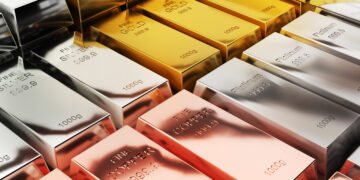

Something that happens maybe once a decade is happening right now. Gold, silver, copper, and uranium are all rising at the same time, and several of them are doing it at or near record prices. That is stranger than it sounds. Precious metals and industrial metals usually answer to different masters. Gold tends to climb when people are nervous about the financial system. Copper climbs when factories are busy and the economy feels strong. When both ends of that spectrum run together, and the fuel that powers nuclear reactors joins the party, the sensible question is not which one to chase. It is what these four very different markets might be trying to say in unison.
The lazy explanation is that everything goes up when money is loose and speculation runs hot. The more useful explanation is that each of these metals is responding to a real, physical story, and for once those stories are all pointing in the same direction.
Gold and the Central Bank Bid
Start with gold, because it set the tone for everything else. The metal pushed past $5,000 an ounce and printed fresh record highs earlier this year before pulling back and trading with real volatility. Goldman Sachs has lifted its end of 2026 forecast to roughly $5,400 an ounce, and plenty of other forecasters sit in the same bullish camp. Forecasts are cheap, though. The number that actually matters is who is doing the buying.
According to the World Gold Council, central banks added about 244 tonnes of gold in the first quarter of 2026, up roughly 3 percent from a year earlier, even with a few sellers showing up in the same window. The Council projects something like 700 to 900 tonnes of official sector buying for the full year, well above the pace that prevailed before 2022. This is the part worth sitting with. Central banks are not momentum traders. They do not panic into charts. When they keep accumulating an asset whose price has already doubled, they are expressing a view about the money they hold rather than a bet on next quarter. Stripped of jargon, that view is that owning a neutral reserve asset has become more appealing than holding another government’s debt. You do not have to share the view to respect what it implies.
Silver, the Smaller and Wilder Cousin
Silver did something in 2025 that markets still underrate. It roughly doubled, a gain of about 120 percent, and it has stayed lively into 2026. Part of the appeal is that silver wears two hats at once. It is a precious metal that trades in gold’s shadow, and it is an industrial metal used in solar panels, electronics, and a long list of modern hardware. That double demand sits on top of a market that has run a structural physical deficit for several years, which means more silver gets used each year than gets produced and recycled.
Here is what makes silver behave the way it does. The silver market is small. A single heavy day of buying in the much larger gold market can equal a meaningful slice of the entire silver market. That is why silver often lags gold for months and then catches up in sudden, violent bursts. Some technical analysts have floated targets as high as $150 an ounce for this cycle. A number like that belongs in the opinion column, not the promise column, because the same leverage that launches silver higher also drags it down hard when the money flows reverse. Silver tends to reward patience and punish the people who show up late and leave in a panic.
Copper Is the Economy’s Wiring
Copper is the least glamorous metal on this list and quite possibly the most important. You cannot electrify anything without it. In 2026 copper futures climbed to records, topping roughly $13,000 a tonne at one point, and Yahoo Finance described the move as a rally that some traders already consider unsustainable. A little skepticism is healthy here. Prices that go straight up tend to come back down to meet reality. But the demand underneath the price is not a passing fad.
The newest buyer in the room is the data center. Demand for copper from data centers alone could reach about 475,000 tonnes in 2026, up from roughly 110,000 tonnes the year before, as companies race to build the computing capacity that artificial intelligence requires. Stack that on top of electric vehicles, aging power grids that need upgrades, and ordinary construction, and global copper demand could climb from about 28 million tonnes in 2025 toward 42 million by 2040. The catch is supply. A new copper mine can take a decade or more to find, permit, and build, and analysts have warned of a potential shortfall on the order of 10 million tonnes if production fails to keep pace. A world that needs far more of something it cannot quickly dig up is the textbook setup for higher prices over time, with the honest caveat that the path there is rarely smooth.
Uranium and the AI Power Problem
Uranium ties the industrial story back to the energy story. The fuel began 2026 at around $80 a pound, spiked to about $101 in late January, then slid back to roughly $84 by the end of the first quarter after the outbreak of war in Iran rattled commodity markets and triggered a selloff. That quick round trip is a reminder that uranium is volatile and reacts sharply to headlines. The longer arc, though, has been steadier and more interesting.
Industry reports through the year have described uranium as entering a multi-year structural bull market, and the logic is simple. The world is committing to nuclear power again, partly because artificial intelligence needs enormous and reliable electricity, and some data center operators have started signing supply deals tied to nuclear generation. At the same time, mine supply has been slow to recover after years of prices too low to justify new projects. Surveys of uranium investors point to a price range of roughly $100 to $135 a pound if supply fails to keep up. The word doing the heavy lifting in that sentence is if, because a single policy change or a restarted mine can shift the balance.
What the Four Metals Have in Common
Pull back far enough and the pattern is hard to miss. Each of these metals is being pulled by a structural source of new demand running into a supply base that cannot expand on command. Gold has the central bank bid and a slow erosion of trust in paper money. Silver has industrial demand layered on a deficit and a tiny float. Copper has electrification and the artificial intelligence build out. Uranium has the return of nuclear power and that same hunger for electricity.
None of this guarantees a straight line higher, and it would be dishonest to pretend otherwise. Copper’s rally has already been called unsustainable by people who watch it for a living. Gold pulled back from its highs. Uranium gave back most of a sharp gain in a matter of weeks. Commodities are cyclical by nature, and the same forces that drive them up tend to overshoot and then snap back. Anyone who buys a chart simply because it is going up is asking for trouble.
The honest takeaway is not a price target, and it is certainly not a recommendation. It is a question worth holding onto. The real economy is signaling a shortage of hard, useful materials at the very moment that the financial system is signaling a shortage of trust in soft, printed ones. Those are two different rooms full of very different buyers, and right now they are reaching the same conclusion. When that happens, the least an investor can do is understand why before deciding what, if anything, to do about it.
_______________________________________________________________________________________________________
This article is written for educational and informational purposes only and does not constitute financial or legal advice. The views and analytical frameworks presented draw on publicly available information and reported commentary from industry participants. Readers are encouraged to consult primary sources and form their own informed views on these complex topics.