
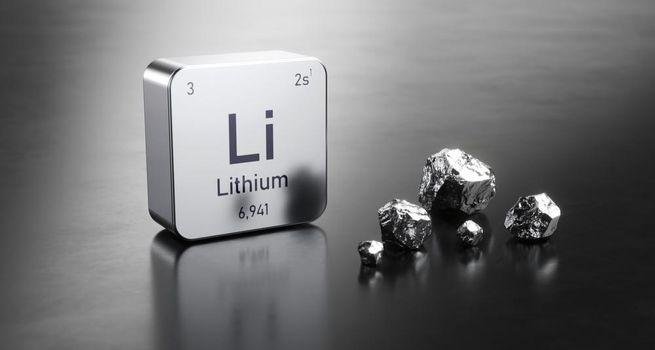
Picture the chart of Chinese lithium carbonate over the past year. It sat around 73,000 yuan a tonne a year ago, ended 2025 near 120,000, blew through 150,000 in January, and topped 200,000 in mid-May. Then it did the thing commodity charts love to do. It went home. Shanghai Metals Market’s battery-grade average fell from 122,350 yuan on October 9 to 104,400 on October 15, a 14.7% drop in a week, and was 102,950 on October 19, below where the year began. The spring excitement is gone. So what actually happened, and what does it say about how to think about a metal that every investor wants to be right about?
A rally built on a supply scare
Start with what drove the run. A big piece of the 2026 surge was not demand at all. It was supply, or more precisely the fear of losing some. According to a late August report in The Northern Miner, the stalled restart of CATL’s Jianxiawo mine was a main driver of the bounce in Guangzhou lithium carbonate futures. The mine would return about 3% of global supply. As of early August no ore loading or crushing was underway, and on August 26 the Yichun environment bureau revoked the acceptance notice for its environmental impact assessment, sending the mine back to care and maintenance. Benchmark Mineral Intelligence then cut its 2026 output forecast for the mine to 32,000 tonnes of lithium carbonate equivalent from 62,500.
Benchmark Mineral Intelligence, cited in the same report, warned that a prolonged delay putting about 4% of global supply at risk could erase this year’s surplus. Read that sentence twice. A market that is in surplus can be flipped by a few percentage points of supply going missing. That is the nature of a small, thinly traded commodity, and it cuts both ways. When the disruption fear fades or the mine looks less critical, the premium drains out.
There was also weather. A late July snowstorm in Argentina’s Catamarca province disrupted Rio Tinto’s 32,000-tonne Fenix operation, per the same report. Individually these are small events. Stacked on top of a market already nervous about supply, they were enough to move prices a long way.
The demand story is real, just smaller than the headlines
None of this means lithium demand is weak. It isn’t. China’s power and energy storage battery output hit 191.7 GWh in May, up 55% from a year earlier, according to the BMI figures reported by The Northern Miner. Lithium iron phosphate chemistry took a record 83.3% of Chinese battery installations in June. BMI expects global battery storage capacity to climb from about 325 GW this year to 1,270 GW by 2035. Grid storage is a genuine, structural source of demand that barely existed as a category a few years ago.
But look at the growth rate. BMI forecasts global lithium demand growth of 5.8% this year, down from 18.5% in 2025, as global electric vehicle sales growth slows to 3.9%. Demand is still rising. It is just rising more slowly than it was, and a price that doubled in a few months was never going to be justified by a number like that.
BMI, which is a unit of Fitch Solutions, said as much. It described current prices as already extending beyond what underlying fundamentals alone would justify. When a research house says that about a market that has just rallied, it is worth listening. Their 2026 average forecast for Chinese lithium carbonate is $20,100 a tonne, against $10,502 in 2025, but the quarterly path they laid out slides to $17,200 in the third quarter and $16,800 in the fourth. They see the market staying in surplus until 2031, with prices around $16,500 in 2027 and a low of $14,500 in 2028. Forecasts are forecasts, and they get revised. Still, the shape of the argument matters more than any single number.
Why supply keeps coming back
Here is the part that tends to get lost when prices spike. High prices are the cure for high prices. BMI expects global lithium production to grow about 13% this year, led by Australia and China. Idled mines are returning, including Mineral Resources’ Bald Hill and Core Lithium’s Finniss, both named in the report. Argentina keeps adding output too. As one market note this month put it, that raises volume but not revenue per tonne.
This is the old commodity cycle, and lithium has run through it before. Prices rise, restarts get announced, new capacity gets financed, and eventually the market is oversupplied again. The investors who get hurt are usually the ones who treated a supply-driven spike as proof of a new normal. The ones who do better tend to separate the long-term demand thesis, which can be perfectly sound, from the short-term price, which can be wildly disconnected from it.
The risk nobody can price cleanly
There is another wrinkle, and it is technological. Sodium-ion batteries use no lithium. BMI flagged them as a long-term threat, noting that CATL’s Naxtra matches lithium iron phosphate on energy density and that CATL expects up to 20,000 electric vehicles to use its sodium batteries this year. That is a tiny number against the global fleet. It is also a proof of concept. Faster-than-expected progress in battery recycling is another downside risk BMI named.
Does that kill the lithium story? Not at all. Nothing in these reports says so, and BMI still expects a deficit from 2031 through 2035. But it does mean the upside case depends on a future that other technologies are actively trying to change. A long-dated deficit forecast is only as good as the assumptions underneath it.
What the stocks have been saying
The equity market, interestingly, never fully bought the spring rally. According to a Rio Times market note, the lithium and battery fund LIT closed at $69.73 on October 9, up about 0.65% on the week, and the note observed that copper and silver gained more over the same stretch. Albemarle closed at $101.27 and SQM at $63.91 that day. A week later, on October 16, LIT had slipped to $64.05, Albemarle to $95.48 and SQM to $60.20, falling with a broad Nasdaq selloff rather than on lithium news. SQM’s shares, around $60 to $64 this month, sit well below their 52-week high in the mid-$90s and well above their low in the low $40s.
That gap between the metal and the miners is the useful signal. Lithium stocks tend to trade on expectations about the cycle, not on the spot price alone. A miner with low costs and a strong balance sheet can survive a price slide that would sink a marginal producer. Equities also look further ahead, which is why they can fall before the metal does and sometimes recover before it too. The same note was careful to point out that LIT holds miners and battery makers, so it is not a pure lithium price, and that is worth keeping in mind before assuming one will simply follow the other.
The practical reading for a self-directed investor is about process rather than prediction. Ask what portion of a price move comes from a supply disruption and what portion comes from demand. Ask whether the idled capacity that would respond to a higher price is still sitting there. Ask where the marginal producer’s costs sit. None of these questions produces a price target. They do produce a clearer sense of whether a rally has legs or merely has momentum.
The lesson in the round trip
It would be easy to read the last year as a story about lithium being volatile. It is, but that is the shallow version. The deeper version is that a commodity can be structurally important and cyclically oversupplied at the same moment, and that both statements can be true for years. Energy storage demand is growing fast. So is supply. The price lives in the tension between them.
The next few months will test it. Watch whether Jianxiawo’s environmental review is reissued and approved, whether Chinese buyers who stayed cautious after the National Day holiday return, and whether prices hold the 100,000 yuan level. The 119,000 yuan support the Rio Times flagged on October 9 has already given way. A move either way will tell you something about how much of the spring rally was fear and how much was fundamentals.
For now, the round trip is the message. A metal went from roughly 73,000 to above 200,000 and back to about 100,000 in barely a year, while the long-term forecasts barely moved. That is not a reason to ignore lithium. It is a reason to be humble about anyone who claims to know exactly where it goes next.
This article is written for educational and informational purposes only and does not constitute financial or legal advice. The views and analytical frameworks presented draw on publicly available information and reported commentary from industry participants. Readers are encouraged to consult primary sources and form their own informed views on these complex topics.