
Four words. That is all it took to set off one of the more interesting intellectual threads circulating in technology and finance circles right now. Elon Musk, CEO of Tesla, SpaceX, and xAI, and one of the most closely watched figures in global business, posted “just mass and energy” in response to a question about what the future economy runs on. The question came from a thread discussing SpaceX’s plans for orbital solar-powered data centers. Most people scrolled past it. But for those paying close attention to the convergence of artificial intelligence, robotics, and energy technology, the comment landed like a thunderclap.
This is not idle speculation from a billionaire with a Twitter habit. It connects to a century-old intellectual tradition in economics, to real infrastructure being built and filed with regulatory agencies right now, and to cost curves in technology that have been moving in one direction, “downward”, for decades without showing any signs of reversing.
A Brief History of What Money Has Actually Been Backed By
To understand where Musk’s comment might be pointing, it helps to understand how the global monetary system has actually worked historically, and how it has changed before.
In the late 1800s, the major industrial powers operated on the gold standard. Each currency was pegged directly to a fixed quantity of gold. The system worked because gold was scarce, portable, and universally trusted. London was the financial center of the world, and the arrangement held for decades. Then World War I arrived. Governments needed to spend far beyond what their gold reserves could support, and they needed to print money to do it. The gold standard broke under the pressure.
After World War II, the world convened at Bretton Woods, New Hampshire, in 1944. Forty-four nations agreed on a new arrangement: the US dollar would be fixed to gold at $35 per ounce, and every other major currency would be pegged to the dollar. It worked because the United States held the majority of the world’s gold reserves and had the only major industrial base left intact after the war.
That system lasted until 1971, when President Richard Nixon closed the gold window. The US had been running persistent deficits, spending on Vietnam, domestic social programs, and the broader obligations of global military dominance, and foreign governments had begun demanding their gold back. There was not enough gold to cover all the dollars in circulation, so Nixon ended the convertibility of dollars to gold on August 15th, 1971. The dollar became what economists call a fiat currency: backed by nothing physical, valuable because governments say it is and because the global financial system is built around it.
But that raised an obvious question: if the dollar is not backed by gold, why does the rest of the world still want it?
The answer is the petrodollar. Following Nixon’s move, Secretary of State Henry Kissinger negotiated an arrangement with Saudi Arabia: the Saudis would price their oil exclusively in US dollars, and in exchange the United States would provide military security guarantees. Because every economy on Earth needs oil, every economy on Earth suddenly needed dollars to buy it. The dollar’s global reserve status was rescued, this time backed not by gold but by energy, specifically by oil.
The pattern across all of these transitions is consistent. The dominant currency has always reflected the dominant economic input of the era. When the underlying economic reality shifted, the monetary system eventually followed. Each time, the transition caught most people off guard.
Three Converging Curves
Which brings us to what is happening right now, and why Musk’s four-word comment deserves serious consideration.
Three major cost curves are converging simultaneously, each moving in a direction that challenges fundamental assumptions about what things cost.
The first is artificial intelligence. The cost of AI training has been falling at roughly 50 times the pace of Moore’s Law, which itself describes one of the most powerful deflationary forces in the history of technology. ResNet-50, a standard AI benchmark, cost approximately $1,000 to train in 2017. By 2019, that figure had dropped to around $10. Today it costs pennies. On the inference side, the cost of actually running an AI model to answer a question or complete a task, GPT-4 level performance cost roughly $20 per million tokens in late 2022. By 2025, comparable performance was available for around $0.40 per million tokens. That is a roughly 50-fold reduction in approximately three years. Chinese AI lab DeepSeek trained its R1 model for approximately $6 million, while Western labs were spending hundreds of millions of dollars for comparable capability. The practical implication is that the cost of cognitive labor, analysis, research, coding, and decision-making based on complex information, is approaching zero at a rate that has no historical precedent.
The second curve is robotics. Industrial robot operating costs currently run around $0.75 per hour when you account for electricity and maintenance. Human workers in comparable roles cost $15 to $20 per hour in the United States. Tesla’s Optimus humanoid robot, designed to perform any task a human can do in the physical world, has a target price of $20,000 to $25,000 per unit. At those economics, each unit is capable of displacing roughly $57,000 per year in human labor costs. The global physical labor market is worth approximately $40 trillion annually. The disruption implied by even a partial deployment of humanoid robotics at scale is almost impossible to overstate.
The third curve is solar energy. Solar module costs have declined 99.6% since 1976, from $106 per watt to approximately $0.38 per watt in recent years, and still falling. Solar is already cheaper than building new natural gas plants in most markets without subsidies. Wright’s Law, which has held for the solar industry for fifty consecutive years, predicts that every time installed solar capacity doubles, module prices drop by another 20%. That trajectory shows no signs of reversing.
When you put these three curves together, a striking question emerges: if AI handles all the cognitive labor, robots handle all the physical labor, and solar handles the energy, what remains as a scarce input? What is left that actually costs something?
The answer, as Musk put it, is mass and energy.
The Intellectual History Behind the Idea
This framing is not new. It draws on nearly a century of economic thinking that has largely sat at the margins of mainstream economics until now.
Frederick Soddy, a Nobel Prize-winning chemist, published a book in 1926 called Wealth, Virtual Wealth and Debt, in which he argued that real wealth derives from using energy to transform materials into goods and services. Financial instruments, money, debt and stocks, are what he called virtual wealth. Physical energy and mass are the real thing.
In the 1930s, the technocracy movement proposed replacing monetary systems with energy certificates, arguing that total currency supply should be tied directly to total energy production. Their core insight was that energy is the fundamental unit of measure common to all productive activity.
In the 1970s, mathematician and economist Nicholas Georgescu-Roegen formalized this into rigorous economic theory, connecting thermodynamics to economics and demonstrating that all economic activity is fundamentally a process of energy transformation, taking energy and using it to rearrange matter into more useful configurations. More recently, research into what has been called the exergy theory of value has developed this further, arguing that economic value maps directly to usable energy.
There are already functioning cryptocurrencies that tie token creation to energy production. The concept of an energy-denominated monetary unit is not theoretical, it exists in operational form today.
The Infrastructure Already Being Built
What has moved this from intellectual history into urgent present-day relevance is the infrastructure now being constructed.
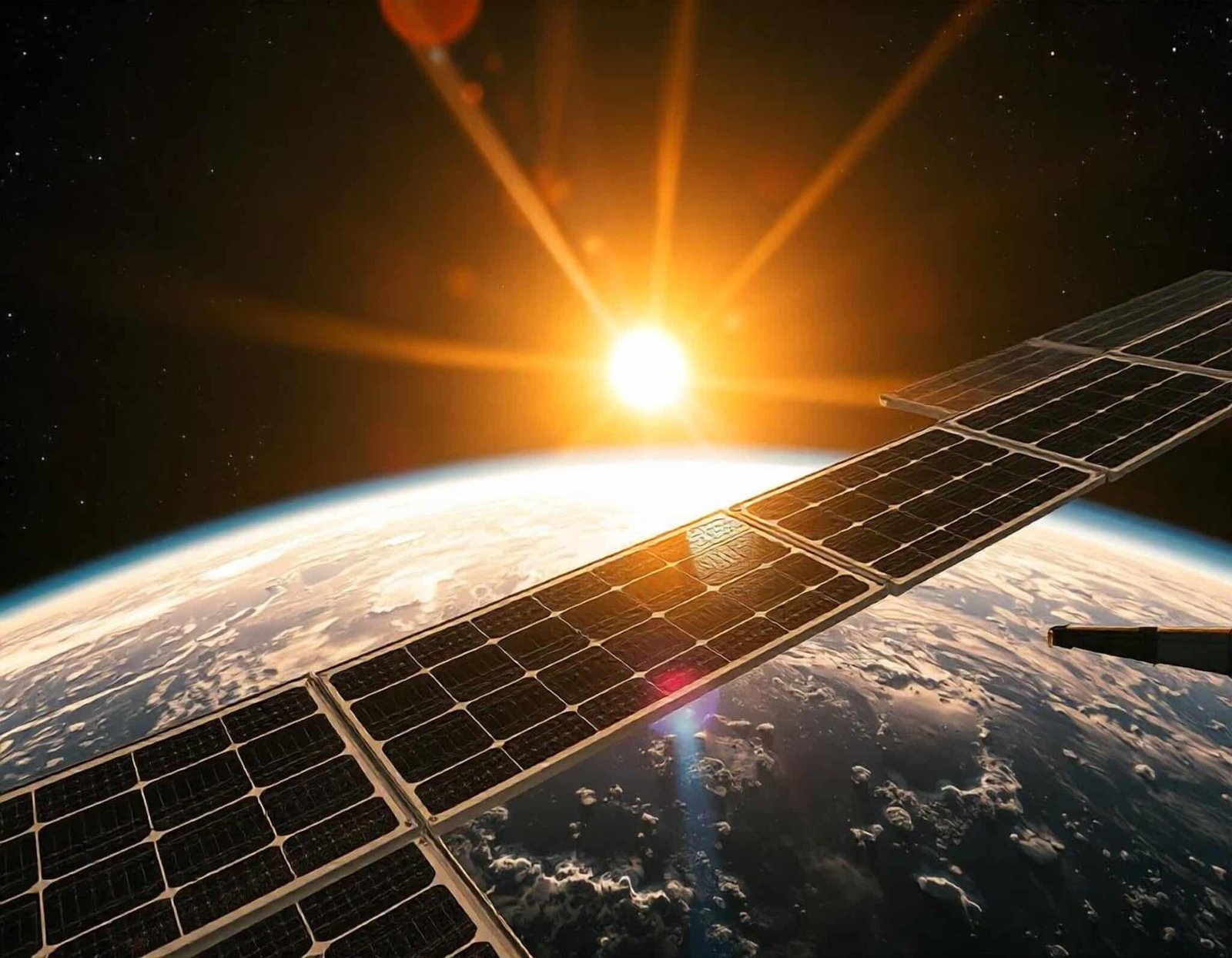
On January 30th, 2026, SpaceX filed with the Federal Communications Commission for permission to launch up to one million satellites. These are not internet satellites like the existing Starlink constellation. According to the filing, these are orbital data centers, solar-powered computing nodes operating in space. The FCC’s space bureau accepted the filing within five days. The satellites would orbit between 500 and 2,000 kilometers above Earth in sun-synchronous orbit, where one side of each satellite faces the sun continuously while the other radiates heat into the cold of deep space.
The physics of orbital solar power are compelling. In space, solar panels receive approximately 1,400 watts per square meter, constantly, without atmospheric interference. On Earth’s surface, peak solar irradiance is roughly 1,000 watts per square meter on a clear day, but the atmosphere absorbs a significant portion on average, and ground-based solar arrays deal with nighttime, weather, and seasonal variation. Orbital arrays operate at capacity factors above 95%, compared to 20 to 30% for ground-based installations. The net result is that an orbital solar array generates approximately 13 times more energy per unit area than an identical ground-based installation.
SpaceX’s own FCC filing stated that the goal of launching a million orbital data center satellites is “a first step towards becoming a Kardashev Type II civilization”, one capable of harnessing the full energy output of its star. That language appears in a regulatory filing submitted to the US government.
SpaceX is not alone in this space. Etherflux, a company founded by Vlad Tenev, co-founder of Robinhood, has raised $60 million and is planning orbital data center nodes with an initial deployment targeted for 2027, using infrared laser technology to transmit power back to ground stations. Power Light Corporation and others are pursuing similar concepts. Orbital solar power is becoming an industry with multiple serious entrants.
The Strongest Objections
A framework this ambitious doesn’t get a free pass, there are real, substantive objections that deserve honest consideration.
The most immediate is fungibility. A kilowatt-hour of solar in the Arizona desert is not the same as a kilowatt-hour of wind power in Norway. Location, timing, and form of energy all matter in ways that money currently abstracts away. This is a genuine problem, though standardized commodity markets for natural gas, oil, and electricity futures already do something similar, they abstract away differences in location and form to create tradeable units of value.
A second objection concerns storability. Money can be saved for decades. Energy dissipates. Batteries self-discharge. But this objection is more powerful against today’s technology than against the trajectory. Battery costs follow their own version of Wright’s Law. Hydrogen, synthetic fuels, and pumped hydro all offer energy storage at scale. And in a world of near-continuous orbital solar generation, the need for long-term storage diminishes, the model shifts from storing energy to generating it on demand.
The strongest objection is political. Monetary policy is an instrument of sovereign power. Central banks use it to manage employment, inflation, and trade. No government voluntarily surrenders that control. But history suggests this objection has limits. Governments did not voluntarily abandon the gold standard, they were forced off it by war spending that outpaced their gold reserves. Nixon did not voluntarily end Bretton Woods, he was forced by deficits that had made the dollar’s gold backing mathematically incoherent. If the economic reality shifts fundamentally enough, the monetary system follows whether governments prefer it to or not.
What It Means
No serious individual is arguing that the petrodollar collapses tomorrow. The institutional infrastructure built around dollar dominance, the US military, global banking systems, treaty arrangements and reserve holdings, has enormous momentum. Transitions of this kind take decades.
But the pattern across five centuries of monetary history is clear. Currency standards change when the underlying economic reality changes. Gold worked until war made it inflexible. The petrodollar worked because oil was the binding resource for industrial economies. If AI, robotics, and solar energy together make cognitive labor, physical labor, and energy itself effectively free, if the only remaining scarce inputs are raw materials and the energy to process them, then the logic of the existing monetary system faces a challenge of a different kind than it has faced before.
Whether that challenge resolves into something resembling an energy-denominated monetary system, or into something no one has quite imagined yet, is genuinely unknown. But the cost curves are real. The infrastructure filings are real. And the intellectual tradition behind the idea is nearly a century old.
Four words. Just mass and energy. It might be worth paying attention.