Artificial intelligence spending is projected to reach $2 trillion by the end of 2026, and this explosive growth will catalyze nine major trends that most people are completely unprepared for. We’re not discussing incremental improvements to chatbots or slight enhancements to existing tools. We’re talking about a fundamental transformation of daily life as we currently know it—from how businesses operate to how we shop, and even how our household appliances function.
After years of investing in AI companies, building AI products, and tracking every significant development in this rapidly evolving space, what’s happening behind the scenes suggests that 2026 will be the most transformative year for artificial intelligence yet. AI is poised to revolutionize businesses, retail experiences, and even mundane household items. Understanding these trends now provides an opportunity to stay ahead of the curve rather than scrambling to catch up later.
Trend One: AI Will Transact With AI
Currently, artificial intelligence performs many useful tasks, but humans remain in the loop for most important decisions. People still employ team members to handle purchases. Every transaction today typically requires human approval. Email communications increasingly involve AI assistance for both writing and responding, but humans still review and send the messages.
This is changing rapidly. Industry experts predict that by 2028, approximately 90% of all business purchases will be handled by AI agents, moving an estimated $15 trillion in spending. The process will look fundamentally different: AI systems will conduct research, make purchases, process returns, coordinate logistics, schedule appointments, and handle transactions—all without human intervention.
A simple example illustrates this shift: A smart refrigerator equipped with AI will monitor its contents, recognize when you’re running low on tomatoes or chicken, and automatically coordinate with other AI systems to purchase and schedule delivery. You’ll never need to manually reorder staples again.
For individuals and businesses, this means your role shifts from placing orders to managing the AI systems that place orders. You’ll configure these systems, monitor their performance, and provide data to improve their decision-making. The AI cannot improve without users learning how to communicate with it, coordinate its activities, and train it effectively. The advantages are substantial: faster ordering, fewer mistakes, and 24/7 operation without breaks, sick days, or errors.
Trend Two: Every Device Gets Genuinely Smart
Most devices in homes today are marketed as “smart” but aren’t actually intelligent. A toothbrush that vibrates isn’t truly smart—it’s just automated. Current “smart” devices exist but don’t learn, personalize, or provide meaningful assistance.
The smart home market is projected to reach $174 billion by the end of 2026. The AI integration happening across devices—toothbrushes, coffee makers, thermostats, doorbells, refrigerators, televisions—will fundamentally change how these devices communicate with each other. Your scale might communicate with your refrigerator, potentially preventing certain food orders if you’ve set weight loss goals.
This means your home becomes an AI-powered assistant that understands your needs and preferences. Everything that’s been electrified will increasingly become “cognified”—equipped with cognitive capabilities. Currently, this is primarily laptops and phones, but everything with power or a battery will eventually have embedded intelligence as AI processors become smaller, faster, and deployable in compact devices. These devices will communicate and coordinate, similar to how workplace automation currently functions.
Trend Three: Everyone Gets a Personal AI Assistant
Currently, most people still manually manage their calendars, emails, and research tasks. Workers spend approximately 60% of their time on administrative work that could be automated or assisted by AI, but most of this work isn’t being meaningfully enhanced by current tools.
The transformation coming in 2026 is significant. Every worker will potentially have access to an AI assistant capable of handling 50-70% of daily tasks autonomously. This isn’t just another tool—it’s an actual AI assistant that learns about you, understands your communication style, knows your values and preferences, and operates with minimal tweaking.
People currently using AI assistants are already saving more than 30 minutes daily, and this represents just the beginning. Imagine waking up to find your AI has already rescheduled conflicting meetings, drafted and sent email replies in your voice, and prepared summaries of all documents and information you need to start your day productively.
This shift allows you to focus on important strategic work. You become the manager of AI systems, configuring and teaching them through a process called RLHF (Reinforcement Learning with Human Feedback). This is how AI systems are currently trained in development environments, but this capability is moving to end users. You’ll provide data for the AI to learn from and feedback to ensure it’s performing correctly, allowing you to focus on creative work, meaningful tasks, and human interactions. Business fundamentally is human-to-human, and AI handles the computational tasks so people can focus on personal connections.
Trend Four: The End of Waiting on Hold
It remains frustrating that when credit card fraud occurs or customer service is needed, people must wait to speak with a human representative. Current support teams require human staff answering calls during business hours, and outside these hours, customers are out of luck.
Research from IBM and Zendesk indicates that AI can handle approximately 80% of customer questions while cutting service costs by 30%. The technology exists but isn’t widely deployed yet. Current implementations allow customers to chat with support systems, book meetings, get questions answered, and qualify leads through interfaces that sound completely human, never complain, and never take days off.
Consider this example: If you want to visit a gym early in the morning but it’s closed, you can’t speak with anyone to sign up, get a day pass, ask questions, or verify equipment availability. A business without AI answering those calls loses potential customers. With AI handling incoming calls, qualifying leads, answering questions, and scheduling appointments, business owners can focus on actually running their businesses.
For customers, this means businesses never close. Help is available 24/7 with no wait times. For business owners, you never miss a lead or potential customer, and you avoid frustrated customers who don’t want to deal with inexperienced staff who may know less about your products than the customers themselves. AI systems possess knowledge that exceeds both customer and support staff combined.
Trend Five: AI Agents Running Entire Departments
Currently, every business department requires human leadership—someone leads sales, support, and finance. Department growth is very human-centric. This is changing dramatically. Forward-thinking finance leaders are already implementing plans where 80% of their work becomes AI-powered.
Tools designed to function as AI-powered chief financial officers allow small business owners to manage and run entire finance departments. The benefit is this frees human workers to focus on team development, strategic thinking, and people management. Industry data suggests that by 2030, approximately 30% of hours currently worked in the United States could be performed by AI.
Instead of hiring five salespeople and three finance staff, businesses might have AI agents handling sales and finance functions. This doesn’t necessarily mean the entire stack becomes automated—perhaps 80-90%—but it definitely won’t remain at current levels of human dependence.
For individuals, this means some will become directors of AI systems rather than managers of people. Human focus shifts to strategy, special cases, major decisions, and proper sequencing of activities and priorities.
Trend Six: Household AI Robots
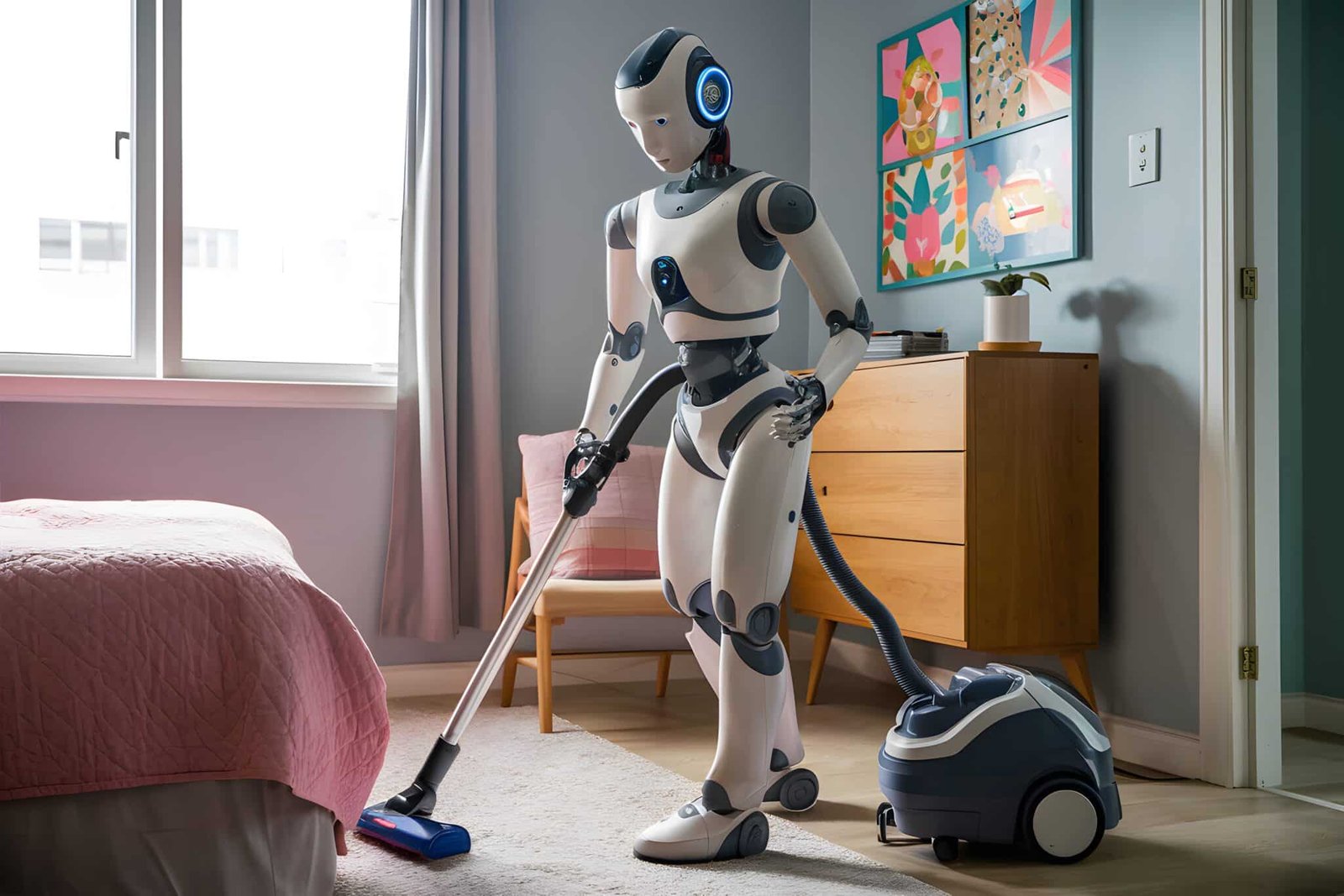
Currently, the most advanced household automation is robotic vacuums. The world coming in 2026 is dramatically different. Affordable AI-powered robots with arms and manipulation capabilities will assist with household tasks—loading dishwashers, cleaning up, and performing tasks that would require a full-time household assistant.
Examples include Optimus by Tesla, Neo (backed by OpenAI), and Figure 3 from Figure AI. These robots learn by observing human actions and demonstrate genuine intelligence. The household robot market is projected to reach $17 billion by the end of 2026. Tesla has 800,000 square feet of production manufacturing space in Texas prepared for Optimus production, and 2026 will see people beginning to encounter robots in friends’ homes.
The implication is profound: all the time currently spent on household chores gets returned to you. Time for the gym, calling family, reading, better childcare, and self-care. Within five years, hiring a human to clean your home may seem as unusual as hiring someone to perform calculations you could do with a calculator.
Trend Seven: AI Robots Will Drive Your Car
Self-driving cars currently exist, with many Tesla vehicles featuring Full Self-Driving capability. However, many car manufacturers face challenges implementing this technology due to the need for specialized AI expertise and hardware modifications.
The emerging solution in 2026: AI-powered robots that can physically operate any vehicle. The same robots performing household tasks or working for companies like BMW or UPS will be able to see roads, use pedals, and turn steering wheels just like humans. Your 2005 vehicle could become AI-enabled. Tesla has announced plans to build 50,000 Optimus robots in 2026 using the same software and hardware as their vehicles.
Consider the productivity gains if you could work on your laptop in the back seat while your robot drives you to appointments. This represents a significant shift in how we think about transportation and time utilization.
Trend Eight: AI-Powered Delivery
Currently, delivery still requires humans—people dropping off Amazon packages, food deliveries, and other items. This limits delivery speed and creates high costs for the “last mile” (from warehouse to home), which is actually the most expensive part of logistics.
In 2026, expect widespread deployment of delivery drones, warehouse robots, and last-mile robots. Some cities already have food delivery robots navigating sidewalks—small autonomous boxes that text customers when they arrive, allowing customers to retrieve their orders while the robot photographs the transaction for verification.
Amazon has stated they aim to deliver 500 million packages annually by drone by 2030, with meaningful implementation beginning in 2026. This creates faster, cheaper delivery for customers. If last-mile costs approach zero, everything becomes less expensive, and entirely new business models become viable. For businesses with delivery components, this represents a fundamental game-changer.
Trend Nine: AI Knowledge Becomes the Biggest Career Advantage
Currently, AI remains a “nice to have” skill for many jobs. Most people are casual users at best, and companies haven’t made AI proficiency a requirement the way they might require proficiency with standard software tools. This is changing rapidly in 2026.
The primary question business leaders are asking is: How do I get my employees to adopt AI? How do I ensure they learn it? AI hackathons will become common. Hiring will prioritize AI-native candidates who can code, build applications, and configure AI systems. If you don’t develop these skills, 2026 will be the year you feel the impact in your career prospects.
This extends beyond using ChatGPT. It encompasses knowing how to use AI tools and prompt them effectively to accomplish your work. The next wave of highly successful entrepreneurs will emerge from AI innovation and expertise. On LinkedIn, job postings mentioning AI have grown 3.5 times faster than any other job category, and AI skills can boost salaries up to 56%.
Learning AI now positions you ahead of approximately 95% of people. Early adopters consistently win big. Those who lag behind get disrupted and left behind. The future isn’t AI versus humans—it’s AI-powered humans versus everyone else. The gap between AI users and AI avoiders widens daily.
A belief that doesn’t support your future isn’t worth maintaining. This transformation cannot be stopped—it’s inevitable. The critical decision is whether you’ll prepare for it in 2026 or find yourself struggling to catch up when it impacts your income, opportunities, and ability to support those you care about. The time to commit to understanding and leveraging AI is now, before the gap becomes insurmountable.