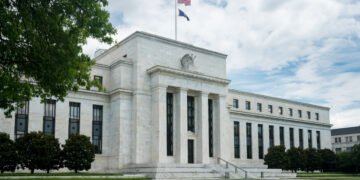

Yesterday afternoon the Federal Reserve raised interest rates for the first time since July 2023. A quarter point, unanimous, twelve votes to zero, taking the target range to 3.75 to 4 percent. Chair Kevin Warsh told reporters the American economy “appears to be strengthening” and that this summer’s inflation readings “do not tell me that underlying trends have meaningfully improved.” The 10-year Treasury yield pushed above 5 percent, a level it has not seen since 2007. Most people watching all of this were watching their stocks. That is understandable and it is also backwards. The part of your portfolio that changed most mechanically yesterday is the part you probably think of as the safe, boring part.
And there is a single number attached to every bond fund you own that tells you almost everything about what just happened to it. Most investors have never looked it up.
The number is called duration, and it is not what it sounds like
Open the page for any bond fund or bond ETF you hold. Somewhere near the yield, usually in a box you have scrolled past a hundred times, there is a figure labeled effective duration or average duration, expressed in years. It might say 2.4. It might say 6.1. It might say 17.
The instinct is to read that as “how long until the bonds mature.” That is close, but the useful meaning is different and far more practical. Duration is a measure of how sensitive that fund’s price is to a change in interest rates. The rule of thumb is about as simple as finance gets: if interest rates rise by one percentage point, a fund’s price falls by roughly its duration, expressed as a percent. Rates fall by a point, the price rises by roughly that same amount.
So a fund with a duration of 6 loses in the neighborhood of 6 percent of its price when yields climb a full point, and gains about that when they drop. A short-term fund with a duration of 2 barely flinches. A long Treasury fund with a duration of 17 is, for practical purposes, a leveraged bet on the direction of interest rates wearing a very conservative-looking costume.
That is the whole mechanism. Bond prices and yields move in opposite directions because a bond paying a fixed coupon becomes less attractive when newly issued bonds pay more, and the only way for the market to make an old bond competitive is to discount its price. Duration just tells you how much discounting it takes.
What 2022 actually taught, and what most people learned instead
The Bloomberg US Aggregate Bond Index returned about negative 13 percent in 2022. It was the worst calendar year in the index’s history, and it happened in the same year stocks fell hard, which broke the mental model a lot of people had about bonds being the ballast that saves you.
Here is what matters about that year. Almost none of that loss came from borrowers failing to pay. There was no wave of defaults in investment grade credit. The loss came from arithmetic. Yields rose fast, and the index had enough duration that the price math did the rest.
The lesson a lot of investors took away was that bonds are dangerous now. The more accurate lesson is that bonds are not one thing. A bond fund’s behavior is governed by a number that is printed in public, updated monthly, and that almost nobody checks against their own situation before buying.
The loss is a timing shift, not a hole in the floor
This is the part that genuinely surprises people, and it is worth sitting with.
When yields rise and your bond fund’s price drops, the fund does not simply become permanently worth less. It also starts earning more. Bonds inside the fund mature, cash comes in, and the manager reinvests it at the new, higher yields. Every month that passes, a larger share of the portfolio is throwing off the better rate.
There is a rough symmetry here that is one of the more elegant ideas in fixed income. Over a holding period approximately equal to the fund’s duration, the immediate price loss from rising rates and the accumulated benefit of reinvesting at higher yields tend to roughly offset each other. The investor who owns a duration-6 fund and needs the money in six years is in a very different position from the investor who needs it in six months, even though they took the identical price hit yesterday.
This is an approximation, not a law. It assumes rates do not keep moving in one direction indefinitely, it ignores credit losses, and reality is messier than the textbook. But the intuition holds, and it reframes the question entirely. The question is not “did my bond fund go down.” The question is “is my duration longer than my time horizon.” If it is, a rate rise genuinely hurts you, because you will be selling before the higher yields have time to do their work. If your horizon is longer than your duration, you are arguably being paid better than you were on Tuesday.
Why the starting yield matters more than the forecast
Here is a related idea that saves people a great deal of wasted energy. Historically, the single best simple predictor of what a high quality bond fund returns over a period near its duration has not been anyone’s interest rate forecast. It has been the yield you bought it at.
That is not a guarantee and nobody should treat it as one. But it explains why a bond investor in 2021, buying at yields near historic lows, was in a structurally poor position no matter how smart they were, and why the starting point available today looks arithmetically different. The 2-year Treasury was yielding roughly 4.74 percent after yesterday’s decision. The 10-year sits just above 5 percent. Those are the inputs. Whether they are attractive depends entirely on what inflation does to them in real terms, which is precisely what Warsh was refusing to declare victory on.
Individual bonds do not escape this, they just hide it
A common response is to buy individual bonds instead of funds, on the theory that if you hold to maturity you get your principal back and therefore cannot lose. The first half of that is true for a solvent issuer. The conclusion does not follow.
If you own a bond paying 3 percent and comparable new bonds now pay 5 percent, you are worse off by a real and measurable amount whether or not anybody prints a price next to your holding. The fund shows you the mark. The individual bond spares your feelings. The economics are the same. There are legitimate reasons to prefer individual bonds, including precise control over maturity dates for known future expenses, but immunity from interest rate risk is not one of them.
Cash is not the free lunch either
The obvious move when rates are rising is to sit in cash and money market funds, collecting a yield with no price volatility at all. It is a reasonable place to be and millions of people are there.
The cost is reinvestment risk, and it is invisible right up until it bites. Cash resets. Whatever the overnight rate does, your money market fund follows within weeks. If the Fed’s path turns, the cash investor’s yield falls immediately while the investor who accepted some duration has locked in the higher rate for years. Yesterday’s projections showed 16 of 18 Fed officials expecting at least one more increase this year, with four seeing room for two, so nobody should assume the turn is imminent. But nobody should assume it never comes either. That uncertainty is exactly why the duration decision deserves thought rather than reflex.
The actual homework
Look up the duration on every bond fund you own. It takes about ninety seconds per fund. Write the numbers down next to the years until you need the money.
If those two columns are wildly mismatched, you have learned something specific and actionable about your portfolio. If they line up reasonably well, you can stop reading Fed coverage with your stomach in a knot, because the arithmetic is already working in your favor. Either way you now know something about your own money that most people who own the exact same funds do not.
This article is written for educational and informational purposes only and does not constitute financial or legal advice. The views and analytical frameworks presented draw on publicly available information and reported commentary from industry participants. Readers are encouraged to consult primary sources and form their own informed views on these complex topics.