
There is a strange thing happening in one corner of the commodities world, and it should make every investor sit up. In most markets, a shortage shows up as a higher price. Demand outruns supply, the number on the screen climbs, buyers grumble, producers cheer, and eventually the market clears. Heavy rare earths are not behaving that way. Some people who actually buy dysprosium and terbium for a living have started saying something that sounds almost absurd on a trading floor: the price barely matters anymore. What matters is whether you can physically get any at all.
That sentence is worth pausing on, because it tells you how far this particular market has drifted from the textbook. When availability becomes the binding constraint rather than cost, you are no longer talking about a commodity in the ordinary sense. You are talking about access, leverage, and national security. And right now, the supply of these obscure metals runs through some of the most unstable ground on the planet.
Where the heavy stuff actually comes from
Most people lump all rare earths together, but the split between light and heavy matters enormously. The light ones, like neodymium and praseodymium, are mined in a number of places, including Mountain Pass in California. The heavy ones, especially dysprosium and terbium, are far rarer and far more concentrated in their origin. These are the elements that let a magnet hold its strength at high temperatures, which is exactly what you need inside an electric vehicle motor, a wind turbine, a fighter jet, or a precision-guided weapon.
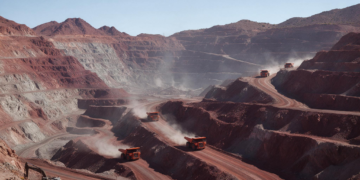
Here is the uncomfortable part. China controls the overwhelming majority of the world’s rare earth separation capacity, by most estimates more than 90 percent, and produces roughly 70 percent of mined output. But China does not even dig up most of its own heavy rare earth feedstock. A large share of it comes from Myanmar’s Kachin State, mined under militia and military-linked arrangements in conditions that range from loosely regulated to lawless. According to Chinese customs data cited by industry researchers, something like two thirds of the terbium and dysprosium processed in China originates in Myanmar. So the global supply chain for the magnets inside Western defense hardware traces back, in part, to a war zone controlled by armed groups, then through Chinese refineries, before anything reaches a factory in Ohio or Bavaria.
This year that chain got tighter. Intensified fighting around the producing regions of northern Myanmar has choked the flow of feedstock, and that is the backdrop for those comments about price no longer being the point. When the raw material itself becomes hard to physically move out of a conflict area, no amount of money guarantees a delivery.
Beijing’s hand on the valve
Layer on top of that the policy picture, which has only sharpened. Back in April 2025, China placed seven categories of rare earth materials under an export licensing regime, requiring suppliers to get approval from the Ministry of Commerce before shipping abroad. Those controls were later widened to cover alloys and certain high-end magnets containing elements like dysprosium and terbium. The core licensing regime has not been rolled back. It is fully enforced today.
A further escalation announced in late 2025 was temporarily suspended, with the pause running until November 2026 as part of a diplomatic arrangement that followed a meeting between the two countries’ leaders. But read that carefully. The expanded measures are suspended, not cancelled, and the original licensing system remains firmly in place. In other words, the most powerful supplier in the market has a working set of levers it can tighten at will, and it has shown it is willing to use them. For any company that depends on these materials, that is not a hypothetical risk. It is a standing condition of doing business.
Does a market function normally when one player controls the refining, sources much of the raw material through a conflict zone, and holds licensing power over exports? Of course it does not. And that is precisely why governments have stopped treating this as a commodities story and started treating it as an industrial policy emergency.
America starts writing checks
The response in the United States has been a steady drumbeat of money and announcements, and the pace picked up noticeably this spring. In early June, the Department of Energy’s Office of Critical Minerals and Energy Innovation announced 134 million dollars for two projects aimed at building domestic rare earth supply from unconventional sources. One of them is striking in its creativity. It involves a demonstration facility near the Gramercy alumina refinery in Louisiana designed to pull rare earths out of “red mud,” the reddish waste byproduct left over from refining bauxite into aluminum. The idea is to take an industrial waste stream that has been piling up for decades and turn it into a feedstock. Other awards in the same vein have gone toward recovering elements from mine tailings and electronic waste.
That is the recycling and recovery angle. The bigger story is the buildout of actual magnet manufacturing on American soil. MP Materials, which operates the Mountain Pass mine, has been moving downstream aggressively. The company expects to begin selling magnets from its Independence facility in Texas in the second half of this year, and it has announced a far larger 1.25 billion dollar campus north of Fort Worth, nicknamed 10X, with construction starting in 2026 and first commercial output targeted for 2028. The Department of Defense took a 400 million dollar position in the company, a remarkable degree of direct government involvement in what is, on paper, a private mining business.
It is not a one-horse race, and the competition has turned sharp. USA Rare Earth has been standing up its own magnet operation, and MP Materials has sued the rival in a Texas court, alleging that a former employee carried proprietary magnet technology out the door. Whatever the merits of that case, the lawsuit itself tells you something. When companies start fighting over trade secrets, it usually means the prize has become genuinely valuable.
What an investor should take away
The temptation here is to treat any rare earth headline as a green light, and that is exactly the trap to avoid. This is a sector where the gap between a press release and a shipping product can run several years, where a single policy decision in Beijing can reset the economics overnight, and where a number of hopeful junior companies will never produce a commercial gram. Building a mine, a separation plant, and a magnet factory is slow, capital-hungry, and unforgiving work. The Fort Worth campus that broke ground this year is not expected to ship product until 2028. That timeline is the rule, not the exception.
What the current moment offers is not a hot tip but a clearer way to think. The heavy rare earth squeeze shows that supply security has become a value in its own right, separate from spot price. Western governments are now willing to spend public money, take equity stakes, and sign long-term offtake commitments to reduce their exposure to a single foreign supplier. That changes the calculus for the handful of companies with real assets, real refining capability, and a credible path to production, because they may operate with a kind of government backstop that did not exist a few years ago. It also means the marginal, story-driven names face a higher bar, since capital and policy support are flowing to the projects that can actually deliver.
Keep your eyes on the boring details. Who has refining capacity, not just a deposit. Who has signed offtake agreements with real buyers. Who is funded through to production rather than dependent on the next financing round. In a market where physical access has started to matter more than price, the companies that can reliably hand over a finished magnet are the ones that count. Everyone else is selling a promise.
_______________________________________________________________________________________________________
This article is written for educational and informational purposes only and does not constitute financial or legal advice. The views and analytical frameworks presented draw on publicly available information and reported commentary from industry participants. Readers are encouraged to consult primary sources and form their own informed views on these complex topics.