
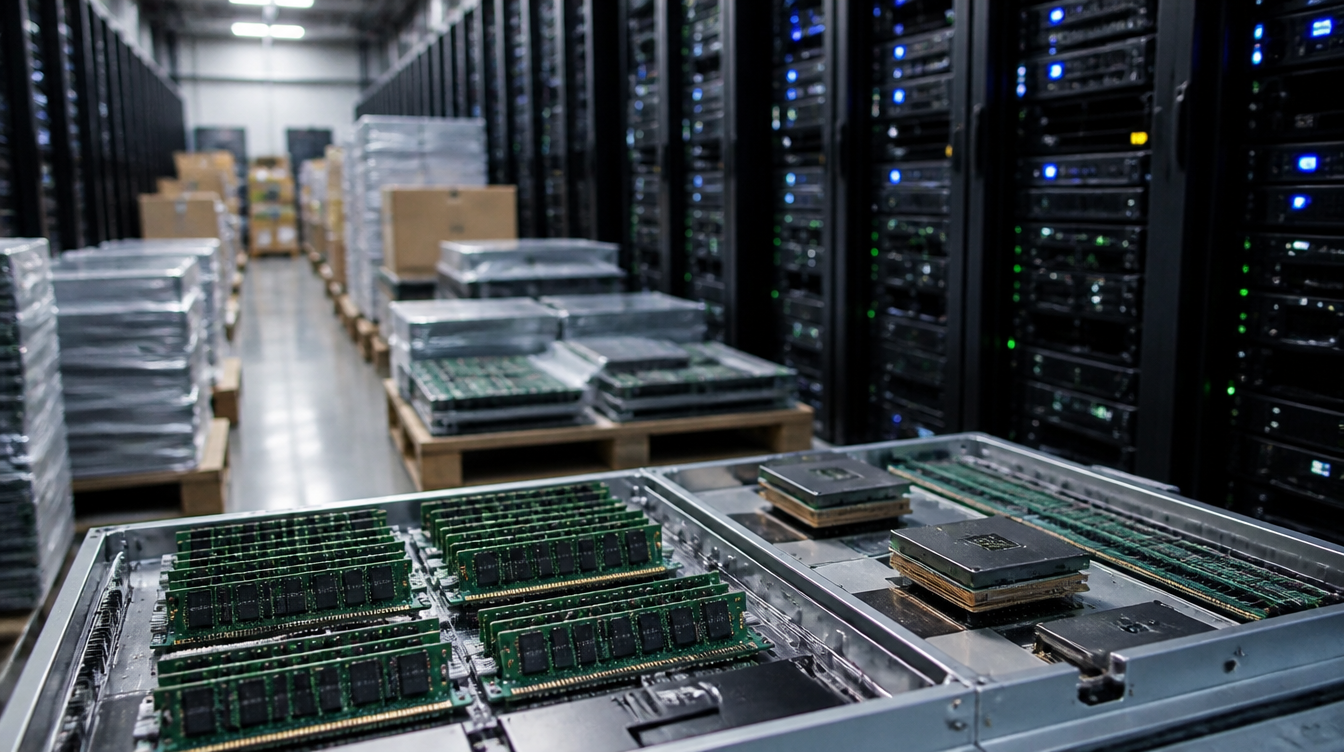
Jeff Clarke said the quiet part out loud this week. Dell's chief operating officer was asked what stands between his company and the mountain of orders sitting on its books, and he did not answer with anything about GPU allocation or power contracts or export licenses. He answered with a chant. "DRAM, DRAM, DRAM, followed by NAND, NAND, NAND." Dell had just reported a record artificial intelligence backlog of about $95 billion. Those are not orders the company hopes to win. They are orders it already holds, from customers already waiting, that it cannot build fast enough because the industry has run out of memory chips.
Sit with that, because it inverts most of what this cycle has trained investors to look for. For three years the AI trade has been a hunt for the single scarce thing. First it was Nvidia's accelerators, and anyone who could get an allocation had a business. Then it was electricity, and the scarce thing became interconnection queues, turbines and substations. Now the constraint has moved again, and it has landed on the most commoditized, most boring, most historically cyclical component in the entire box.
A Record Backlog Is Not the Same Thing as a Record Quarter
Dell's numbers for the quarter ended July 31 were enormous by any standard. Revenue of about $47 billion, up 58% from a year earlier. Its Infrastructure Solutions Group, the division that sells servers and storage, hit a record $31.8 billion, up 89%. The company booked nearly $61 billion in AI server orders in those three months alone, and more than $130 billion over the trailing twelve months. Adoption of its AI Factory platform has passed 6,500 customers, and 3,300 of those signed on in just the last three quarters. By Dell's own account, it took two years to land the first 3,200.
So why is the most interesting number the one that did not convert?
Because a backlog is a promise, not a payment. Revenue sitting in backlog has not been recognized, has not been collected, and is exposed to everything that can happen between now and delivery. Clarke was candid about the pressure. Configurations, he said, "cost more than they did last quarter, and the quarter before, and the quarter before." Some customers are responding by deferring purchases outright because they cannot stretch existing budgets far enough. Others are ordering further ahead than they ever have, effectively queueing for supply that does not exist yet. That behavior tells you the demand is real. It also tells you the order book contains a great deal of hedging.
HPE told a nearly identical story a day later. Revenue of $12.2 billion for its third quarter, up 34%. Record bookings, record backlog, AI systems orders of $2.4 billion, up more than 30% sequentially. And then the same brake. Chief executive Antonio Neri pointed directly at DDR5, DDR4 and NAND, and noted that the transition from conventional DRAM to high bandwidth memory is intensifying the squeeze. When two direct competitors describe the same wall in the same week, it is not a company problem. It is an industry condition.
How the Least Glamorous Chip Became the Choke Point
The mechanism is not complicated, which is part of why it got overlooked. High bandwidth memory, the stacked DRAM that sits beside an AI accelerator and feeds it data, is far more profitable per wafer than the ordinary DRAM that goes into laptops, phones and standard servers. It is also far hungrier. A Micron executive has put the figure at roughly three times the wafer capacity per gigabyte compared with standard DRAM. So every gigabyte of HBM the industry produces for AI consumes something like three gigabytes worth of manufacturing capacity that used to serve everyone else.
Samsung, SK Hynix and Micron have all tilted toward the higher margin product, and the consequences showed up fast. SK Hynix told investors its HBM, DRAM and NAND capacity was essentially sold out for 2026. Micron withdrew from the consumer memory market altogether to concentrate on enterprise and AI customers. Samsung lifted the price of a 32GB DDR5 module to $239 from $149, an increase of about 60%, and its own global marketing head warned publicly that supply issues would touch everyone in the industry, not just Samsung. Gartner has forecast DRAM prices rising roughly 47% across 2026.
Can the industry simply build more? Eventually. Samsung has a new memory line planned at its Pyeongtaek plant in South Korea, but mass production is not expected to begin until 2028. Fabs are not the sort of thing anyone spins up because this quarter's spot price looks attractive. That lag is precisely why memory has always been the most violently cyclical corner of semiconductors, and why the current shortage is not going to resolve on the timeline that anyone building a data center this year would prefer.
Nvidia Already Voted With Its Balance Sheet
Read Nvidia's most recent quarter through this lens and it looks different. The headline was another record: revenue of about $96.2 billion for the quarter ended July 26, up 106% from a year earlier, with data center revenue of $89.0 billion. But the disclosure that matters here sits further down the page. Nvidia's supply and capacity commitments jumped from $119 billion in the prior quarter to $279 billion, and the company stated plainly that the increase was primarily related to the procurement of memory.
That is a company with arguably the best demand visibility in the industry locking in years of memory supply at whatever it takes. It is also, quietly, a company telling you where it thinks the risk sits.
There is a second tell in the same filing. Nvidia's edge computing segment grew 27%, but the company noted that consumer PC sales were tempered by elevated memory and systems prices. The AI buildout has become expensive enough at the component level that it is now showing up in the price of ordinary computers. That is not a rounding error. That is a capital spending boom reaching into household budgets through the supply chain, and it is worth watching as a small but real contributor to goods inflation.
What This Actually Changes for Investors
The first shift is analytical. In a supply constrained market, headline revenue growth stops being the most informative variable, because it measures what a company managed to ship rather than what it could sell. Backlog conversion becomes the number to watch. So does gross margin, because the question underneath every one of these results is who absorbs the memory cost. Dell and HPE buy DRAM at market. Their customers may or may not accept the pass through. Watch whether margins hold as revenue climbs, and be skeptical of any narrative in which both expand effortlessly.
The second shift concerns position in the chain. Scarcity relocates profit. When accelerators were the bottleneck, the accelerator maker captured the value, which is why one company came to dominate the story. If memory is the bottleneck now, then pricing power sits with the three firms that make it, and the margin squeeze sits with everyone who assembles boxes around it. That is a very different distribution of winners than the one most AI-heavy portfolios were constructed around in 2024.
The third point is the uncomfortable one. Memory is cyclical in a way accelerators have not yet had to prove they are. Capacity added during a panic tends to arrive all at once, and it tends to arrive after the panic has passed. The same fabs that cannot keep up in 2026 will finish their expansions eventually, and history suggests they will finish them together. Anyone extrapolating today's memory pricing into a permanent condition is making an assumption this industry has punished repeatedly.
None of this suggests the AI buildout is hollow. About $95 billion of unfilled orders at one vendor, and a record backlog at another, is roughly as concrete as demand evidence gets. What it does suggest is that the constraint has moved, that the market has not fully repriced for where it moved to, and that the most useful question over the next few quarters is not how much anybody booked. It is how much they can actually deliver, and what it cost them to get the parts.
This article is written for educational and informational purposes only and does not constitute financial or legal advice. The views and analytical frameworks presented draw on publicly available information and reported commentary from industry participants. Readers are encouraged to consult primary sources and form their own informed views on these complex topics.