
Oracle just delivered a quarter that on paper looked like vindication. Revenue climbed 30 percent, its cloud business grew 60 percent, and the backlog of contracted future business swelled to $664 billion. Any other year, that would be a victory lap. Instead the stock barely budged, because a growing number of investors are asking a far less comfortable question about the entire AI buildout: who is actually paying for all of this, and what happens if the bill comes due before the returns show up?
That question, more than any new chip launch or model release, is the one that matters right now for anyone holding AI adjacent stocks. It sits underneath the headline capital expenditure numbers, the multi hundred billion dollar partnership announcements, and the increasingly loud warnings from skeptics who think the industry has built something closer to a financing pyramid than a technology revolution.
Oracle’s Balance Sheet Becomes the Test Case
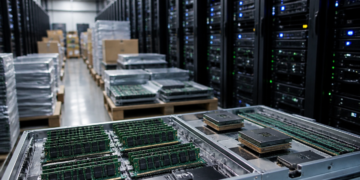
Start with Oracle, because it has become the poster child for the debt side of this story. As of the quarter ended August 31, the company was carrying just over $125 billion in total debt against a book value of roughly $67 billion, a debt load nearly double the value of the company on paper. Capital expenditures for the quarter alone topped $28 billion, on top of nearly $56 billion spent in the prior fiscal year, largely to build out the data center capacity behind its Stargate partnership with OpenAI, a deal reportedly worth around $300 billion over five years.
Oracle still generated real profit, $4.7 billion for the quarter, and holds about $37 billion in cash and marketable securities. Interest expense of roughly $1.4 billion a quarter is manageable for now. But the math only works if that backlog converts into cash flow on schedule, and if the AI demand behind it doesn’t slow down. One analyst summed it up fairly generously, noting Oracle is positioned to keep investing while still being able to pivot if the industry hits a wall. That is a more honest way of putting it than the bulls usually do. It is a bet, not a certainty, and Oracle has effectively borrowed heavily to make it.
A Web of Deals That Keep Pointing Back to Each Other
Oracle is not alone, and it is not even the most tangled example. Look at the broader map of AI financing and you start to notice the same handful of dollars seem to move in circles. Nvidia has committed up to $100 billion to OpenAI over a decade, while OpenAI has agreed to buy 10 gigawatts of Nvidia powered infrastructure in return. Microsoft and Nvidia together put roughly $15 billion into Anthropic, which in turn is expected to spend around $30 billion on Microsoft’s cloud and Nvidia’s chips. AMD handed OpenAI warrants to buy its stock at a nominal price as part of a chip supply agreement. Nvidia owns a stake in CoreWeave and sells it hardware, while OpenAI holds equity in CoreWeave too. And Nvidia has separately backed a data center acquisition tied to xAI along with a chip leasing arrangement worth billions more.
Every one of these deals makes sense in isolation. Taken together, they describe an industry where the same small circle of companies are simultaneously suppliers, customers, investors, and lenders to one another. Financial analyst Gregory Blotnick has pointed out the obvious risk in that structure: because the investments are so interconnected, trouble at any single node could cascade through the rest surprisingly fast. Economist Andrew Odlyzko has raised a related worry, that if confidence in large language model demand ever slips, order books built on these mutual commitments could unwind quickly, dragging valuations down with them. None of this means the deals are fraudulent or even unwise. It does mean the AI trade has less independent verification of real end demand than the headline numbers suggest, since a meaningful share of the revenue one company books is being funded, directly or indirectly, by another company’s promise to spend.
Burry Isn’t Wrong to Ask the Question
Michael Burry has made a career out of being early and occasionally insufferable about it, and his recent AI bets fit that pattern. He has taken short positions against Micron, disclosed sizable put options on Nvidia and Palantir, and expanded bearish wagers to Tesla, Caterpillar, Applied Materials, and semiconductor exchange traded funds. His public commentary has not been subtle, at one point declaring the AI narrative “nothing more than mass addiction” and warning that it “may die a death by a thousand cuts.” When Samsung and SK Hynix announced a new chip hub in South Korea, he called it “the beginning of the end.”
It is easy to dismiss this as showmanship from a man whose reputation rests on one famous prediction two decades ago. But strip away the theatrics and his underlying argument tracks with the circular financing concern above. Chip makers rally because hyperscalers spend, equipment suppliers rally because chip makers expand, and each new headline gets treated as proof that demand will keep compounding forever. That is precisely the kind of self reinforcing logic that inflates bubbles, whether or not this one ends the same way past bubbles did. Being skeptical of Burry’s timing does not require dismissing his framework.
The One Constraint Money Can’t Solve
Here is the part of the story that gets less attention than the financing drama, and arguably matters more for the long run. PwC estimates the world will need roughly $31.6 trillion in cumulative data center investment through 2050, with annual spending rising from about $800 billion today to $1.8 trillion by midcentury. The United States alone accounts for an estimated $15.1 trillion of that total. But PwC’s own analysis identifies the binding constraint, and it isn’t capital. It’s electricity. Getting a new data center connected to the grid typically takes four to ten years, far longer than the two to three years needed to actually build the facility itself.
That mismatch matters because it means the AI buildout cannot simply be willed into existence faster by throwing more debt or equity at it. Power availability sets the pace, regardless of how much Wall Street wants to finance. Under a scenario with tighter chip export controls, PwC estimates total investment through 2050 would fall by roughly $6 trillion. Policy, not just enthusiasm, turns out to be part of the ceiling here too.
What This Means for Anyone Watching From the Sidelines
None of this is a reason to declare the AI trade a fraud or a bubble about to pop on a specific date, and nobody credible is claiming to know that timeline. What it does argue for is a more skeptical read of headline numbers. When a company reports a massive backlog, it is worth asking how much of that backlog is funded by another company’s own borrowing. When capital expenditure guidance gets raised again, it is worth asking whether the underlying demand is coming from paying end users or from a partner’s balance sheet. And when the bulls point to gigawatts and trillions as proof the story is unstoppable, it is worth remembering that a data center still needs a working power line before it generates a dollar of revenue.
The AI buildout may well justify itself over the next decade. The compute is real, the model improvements are real, and plenty of the underlying business use cases are already paying for themselves. But real technology and sound financing are not the same thing, and right now the financing side of this story deserves at least as much scrutiny as the technology does.
This article is written for educational and informational purposes only and does not constitute financial or legal advice. The views and analytical frameworks presented draw on publicly available information and reported commentary from industry participants. Readers are encouraged to consult primary sources and form their own informed views on these complex topics.